
Some film series I’ve curated.

Forever Young: Cinema in relief
April 21-22, 2026
Catalog Essay:
Near the end of the 1940s —approaching the dawn of the first, short-lived wave of 3D features produced by Hollywood studios— Soviet filmmaker Sergei Eisenstein professed his faith in the format’s forthcoming success. “To doubt that tomorrow belongs to stereocinema,” he wrote, “is just as naïve as it is to doubt the very coming of tomorrow!” As we know, history played out a bit differently. Unlike most new formats that have joined cinema’s toolbox in the last hundred years —the arrival of sound, of colour, widescreen aspect ratios, and surround sound mixes— 3D has never managed to harness its spectacle, to become subservient to narrative and character-driven storytelling. Instead, it pokes its fingers in our eyes, gets put into time-out, disappears, is reborn, fades away, and arrives once again many years later having never managed to join the industry’s adult table.
3D is a true Peter Pan format. It’s always emerging and re-emerging in a youthful demonstration mode, perpetually learning how to behave and what good manners are. Rarely content to merely show objects and spaces in depth, filmmakers tend to use 3D as an opportunity to provoke our eyes, to thrust things and substances out of the screen at us — a fascination with breaking the fourth wall that the format borrows from early cinema, when cineastes weren’t so concerned with pretending that the camera, screen, and audience were nonexistent. These ruptures, like the movement of life on screen and the spatio-temporal shocks of montage, offer sensations that could be deemed the films’ true raisons d’être; the best of them not only introduce us to new, previously unimaginable images, but also encourage us to learn new ways of looking and seeing.
Like early cinema’s “attractions” mode, which Tom Gunning reminded us never truly disappeared after narrative became the medium’s standard mode of production in the 1910s, 3D has also developed a life in the underground. While the bespectacled format has become an avatar for the industry’s march toward formulaic franchise blockbusters, global market expansion, and egregious revenue maximization, stereoscopy has meanwhile preoccupied the imaginations of a number of artists and DIY filmmakers since the 1930s. Looking back at the history of these explorations —rooted more in science, personal self-reflexivity, and genuine curiosity than any default gimmicks inflicted upon us by studio technicians— “Forever Young: Cinema in relief” celebrates a century of 3D’s most primal, intimate, and expressive energies.
– Blake Williams
Programme 1 | Invention Without a Future:
Taking its name from Louis Lumière’s famous declaration about cinema at its very moment of inception, this programme looks at stereoscopic films made in five different formats more than 90 years apart — all celebrating acts of looking and varieties of movement; all implicitly posing the question: where can we possibly go from here?
- Films:
– Arrival of a Train 3D (1935, Louis Lumière, Polarized 3D)
– Opening the Nineteenth Century: 1896 (1990, Ken Jacobs, 16mm, Pulfrich glasses)
– Olympiad (1971, Lillian F. Schwartz, ChromaDepth glasses)
– Orbit (2006, Kerry Laitala, 16mm, ChromaDepth glasses)
– Airship 1 (2012, Kenneth Anger, Anaglyph glasses)
– Tulsa (2025, Scott Stark)
– FELT (2025, Blake Williams, Polarized 3D)
Programme 2 | Material Worlds:
Cinema’s founders, Louis & Auguste Lumière, frequently balked at suggestions that they were engaged in a film “production” practice. Rather, they believed that their interests and motives belonged to a tradition of scientific research. After all, the medium is nothing if not a complex system of various technological processes and alchemical reactions, even now in this predominantly digital era. To remind of this, the films in the programme focus and zoom in on the material nature of their own construction.
- Films:
– 3D Movie (1975, Paul Sharits, 16mm, Anaglyph glasses)
– Dimensional Excursions (2024, Peter Rose, Polarized 3D)
– toward a fundamental theory of physics (2025, Victor Van Rossem, Polarized 3D)
– Gyromorphosis (1956, Hy Hirsh, 16mm, Pulfrich glasses)
– Wall (1987, Takashi Ito, 16mm)
– Photosynthesis (2023, Brian Zahm, ChromaDepth glasses)
– Let Your Light Shine (2013, Jodie Mack, Diffraction glasses)
Programme 3 | Memento vivere:
3D cinema has been repeatedly linked to, and held back by, expectations that it offers a heightened sense of realism. “A lion in your lap! A lover in your arms!” promised the tagline of Hollywood’s first 3D feature, Bwana Devil (1952). Story-telling, diary-keeping, world-traveling spectacle — cinema, the ultimate empathy machine, finally delivering the world to us in coherent temporal and spatial depth. In truth, of course, 3D movies distance us from real experience even more than regular cinema does. The distorted scale and grotesque, volumetric renderings of reality render the visible into something veritably alien and abstract, reminding us: life is for living, cinema is for anything else. This programme is dedicated to dispelling this myth of 3D realism.
- Films:
– Twelve Tales Told (2014, Johann Lurf, Polarized 3D)
– more than everything (2018, Rainer Kohlberger, Polarized 3D)
– Pixillation (1970, Lillian F. Schwartz, ChromaDepth glasses)
– The Day Was a Scorcher (2009, Ken Jacobs)
– 2012 (2013, Takashi Makino, Pulfrich glasses)
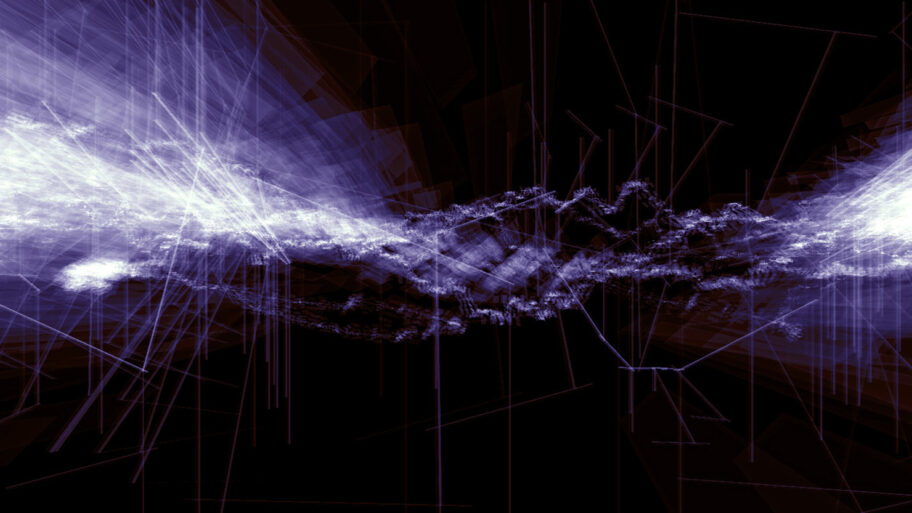
Dimensional Excursions: Innovation in 3D Cinema
July 17, 2025
Catalog Essay:
“To doubt that tomorrow belongs to stereocinema is just as naïve as it is to doubt the very coming of tomorrow!” —Sergei Eisenstein
Unlike other major technical enhancements to arrive in the last hundred years—sound, colour emulsion, widescreen aspect ratios, and surround mixing—and despite being greeted with substantial public enthusiasm at the onset of its notable waves in the mid-1950s, early 1970s, and late 2000s, 3D has, for myriad reasons, never managed to become a production or exhibition standard. This intermittency has no doubt affected the format’s ability to mature, suspending it in a perpetual “demonstration” phase that privileges the wonder of its technological accomplishment, and taking no shame in drawing audiences’ attention to its full formal potential.
3D’s “look at me!” attitude never goes away. Indeed, stereoscopy could be thought of as cinema’s Peter Pan format—the attention-seeking child that can’t grow up, instead opting to chase its own shadow. Thus, we celebrate 3D’s primal and flamboyant energy, showcasing films made by artists and filmmakers who take playful and innovative approaches to the third dimension.
The link between 3D spectacle and early cinema—an era famously described using the term “cinema of attractions” by historian Tom Gunning—runs deep. That period’s sensibility, marked by the image’s drive toward visibility and a direct address to the spectator, is abundant in this program, where attractions abound in both narrative and experimental contexts. In “Planes, Frames, and Autostereoscopy,” we present a collection of shorts made by several trailblazing film and video artists to showcase a spectrum of unorthodox stereoscopic effects, for which we’ll provide five different kinds of 3D glasses.
In a longer form, Ulysses in the Subway (2017) takes us on a stunning journey through the literal underground, as members of the multidisciplinary digital arts collective OpenEndedGroup collaborate with the godfather of experimental 3D, Ken Jacobs, and his partner Flo, algorithmically generating all of the film’s images from a field recording captured in New York’s subway system. As if it still needs to be said, these films can make you feel in ways you never imagined, and that effect is inextricable from their 3D presentation.
– Blake Williams
Feature Films:
- Ulysses in the Subway (2016, Ken and Flo Jacobs, & OpenEndedGroup [Marc Downie & Paul Kaiser], Polarized 3D)
– preceded by Around is Around (1953, Norman McClaren, Polarized 3D)
Shorts Program:
- 3D Shorts: Planes, Frames, and Autostereoscopy
– Dimensional Excursions (2024, Peter Rose, Polarized 3D)
– 3D Movie (1975, Paul Sharits, 16mm, Anaglyph glasses)
– UFOs (1971, Lillian F. Schwartz, ChromaDepth glasses)
– Above the Rain (2019, Ken Jacobs)
– cinéma concret (2015, Takashi Makino, Pulfrich glasses)
– Let Your Light Shine (2013, Jodie Mack, Diffraction glasses)
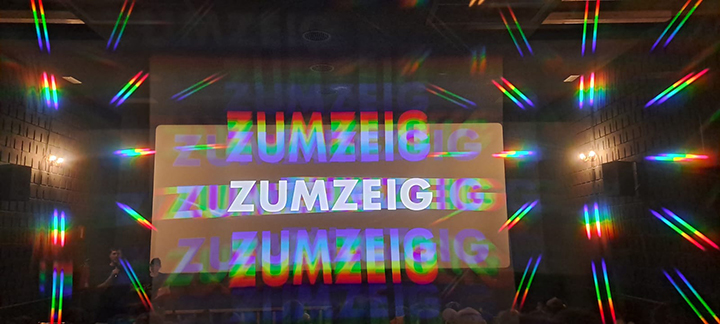
Short 3D film session: inner and outer worlds
Screening date: February 21, 2025
“This session is a unique experience that immerses us in the history of experimental 3D techniques. Programmed and presented by filmmaker Blake Williams, the audience will have a chance to combine four different three-dimensional glasses (Anaglyph, Pulfrich, ChromaDepth and Diffraction) during the screening.” – Miquel Martí Freixas
- Program:
– Opening the Nineteenth Century: 1896 (1990, Ken Jacobs, 16mm, Pulfrich glasses)
– Other Urban Lives (2023, Ken Jacobs)
– Red Capriccio (2014, Blake Williams, Anaglyph glasses)
– Airship 1 (2012, Kenneth Anger, Anaglyph glasses)
– Wall (1987, Takashi Ito, 16mm)
– Apotheosis (1972, Lillian F. Schwartz, ChromaDepth glasses)
– Photosynthesis (2023, Brian Zahm, ChromaDepth glasses)
– Speechless (2008, Scott Stark)
– Let Your Light Shine (2013, Jodie Mack, 16mm, Diffraction glasses)
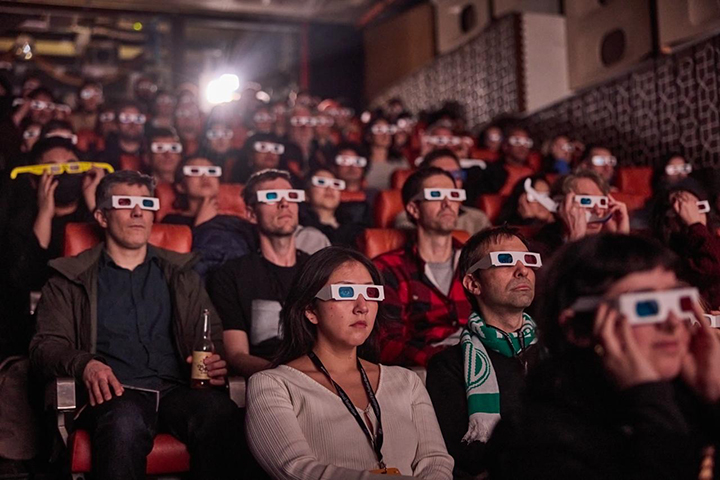
sound//vision: Cinema of the Spectacles
Screening date: February 4, 2025
“A unique experience that immerses us in the history of experimental 3D techniques. Programmed and presented by filmmaker Blake Williams, the spectator will combine a diversity of three-dimensional glasses (Anaglyph, Pulfrich, ChromaDepth, Diffraction) with 16mm works by Paul Sharits, Hy Hirsh, Ken Jacobs, Takashi Ito, Kerry Laitala, Jeff Scher and Jodie Mack. Filters that change from one eye to the other, optical polyrhythms and illusions of depth, all will be part of this unforgettable Cinema of the Spectacles‘ journey.” – Miquel Martí Freixas
- Program:
– 3D Movie (1975, Paul Sharits, 16mm, Anaglyph glasses)
– Gyromorphosis (1956, Hy Hirsh, 16mm, Pulfrich glasses)
– Opening the Nineteenth Century: 1896 (1990, Ken Jacobs, 16mm, Pulfrich glasses)
– Wall (1987, Takashi Ito, 16mm)
– Orbit (2006, Kerry Laitala, 16mm, ChromaDepth glasses)
– Turkish Traffic (1998, Jeff Scher, 16mm, ChromaDepth glasses)
– Let Your Light Shine (2013, Jodie Mack, 16mm, Diffraction glasses)
Dimensional Excursions: A Century of Innovation in 3D Cinema
November 30, 2024 – January 1, 2025
Catalog Essay:
“To doubt that tomorrow belongs to stereocinema is just as naïve as it is to doubt the very coming of tomorrow!” —Sergei Eisenstein
Nearly eight decades after Eisenstein, like so many before him and even more after, presumed that the future of cinema belonged to 3D, the format continues to enjoy a stunted existence in the movie industry. Unlike other major technical enhancements to arrive in the last hundred years — sound, colour emulsion, widescreen aspect ratios, and surround mixing — and despite being greeted with substantial public enthusiasm at the onset of its notable waves in the mid 1950s, early 1970s, and late 2000s, 3D has, for myriad reasons, never managed to become a production or exhibition standard. This intermittency has no doubt affected the format’s ability to mature. Scott Higgins, a historian who wrote extensively about the emergence of Technicolor in the 1930s, noted how new cinema formats tend to evolve from an initial period of vibrant innovation into a restrained mode wherein they swiftly become subservient to narrative storytelling. Films made during early “demonstration” phases tend to display the wonder of the technological accomplishment, and take no shame in drawing audiences’ attention to its full formal potential.
3D’s “look at me!” attitude has never gone away. Indeed, stereoscopy could be thought of as cinema’s Peter Pan format — the attention-seeking child that never grows up, instead opting to forever chase its own shadow. This series celebrates 3D’s primal and flamboyant energy, showcasing films made by artists and filmmakers — from the avant-garde and major studios both — who take playful and innovative approaches to the third dimension. In October 2024, we lost two such storytellers: Paul Morrissey (director of Flesh for Frankenstein) and Lillian F. Schwartz (whose film Mutations screens as part of our shorts programme). We’re honoured to present their work as part of this series.
We open, as the art of cinema did, with a train entering the station, screening a rare presentation of Louis Lumière’s 3D remake of the iconic L’Arrivée d’un train en gare de La Ciotat (1896). Nearly 40 years after jolting many spectators out of their seats at the sight of a projected locomotive, Lumière fulfilled his dream of a 3D moving image — an upgrade that may well have sent attendees of the French Academy of Science’s 1934 meeting through the roof. We’ve paired this 50-second masterwork with Martin Scorsese’s magical 3D feature, Hugo (2011), which, in addition to paying stereo-homage to many other early cinema treasures, includes its own bombastic rendition of the Lumières’ actualité.
The link between 3D spectacle and early cinema — an era famously described using the term “cinema of attractions” by historian Tom Gunning — runs deep. That period’s sensibility, marked by images’ drive toward visibility and a direct address to the spectator, is abundant in these films, where attractions abound in both narrative and experimental contexts. A collection of short films by several trailblazing film and video artists showcases a range of unorthodox approaches to producing stereoscopic effects in six varieties of glasses formats, while a presentation of two late Godard films, Les trois désastres (2013) and Adieu au langage (2014) — the only two works he made in what he endearingly referred to as “hopeless 3D”— point us toward new, abrasive, and previously indescribable sensations that only a 3D film could manifest.
Throughout the series, films will offer opportunities to see and experience the world anew. Completing our train triptych, Ulysses in the Subway (2017) provides a stunning journey through the literal underground, as members of the multidisciplinary digital arts collective OpenEndedGroup collaborate with the godfather of experimental 3D, Ken Jacobs, algorithmically generating all of the film’s images out of a field recording captured in New York’s subway system. From images of the unseeable to images you can’t unsee, the series wouldn’t be complete without the sensory jolts provided by horror classics like André De Toth’s deranged House of Wax (1953) and Julian Roffman’s nightmarish The Mask (1961) — a pair of haunting films that transcend their shocks to the body and mind, but which nevertheless may seem downright quaint when considered next to the pure abjection emanating out of cult darlings like Flesh for Frankenstein (1973) and Jackass 3D (2010). The effectiveness of the latter rests on the depth illusions signalling to your stomach that you, too, are bungee-jumping inside an uncleaned porta-potty.
As if it still needs to be said, these films can make you feel in ways you never imagined, and that effect is inextricable from their 3D presentation.
– Blake Williams
Feature Films:
- Hugo (2011, Martin Scorsese, Polarized 3D)
– preceded by Arrival of a Train 3D (1935, Louis Lumière, Polarized 3D) - Flesh for Frankenstein (1973, Paul Morrissey, Polarized 3D)
– preceded by Speechless (2008, Scott Stark, 16mm) - Goodbye to Language (2014, Jean-Luc Godard, Polarized 3D)
– preceded by Les trois désastres (2013, Jean-Luc Godard, Polarized 3D) - House of Wax (1953, André De Toth, Polarized 3D)
- Jackass 3D (2010, Jeff Tremaine, Polarized 3D)
- The Mask (1961, Julian Roffman, Polarized 3D)
– preceded by Around is Around (1953, Norman McClaren, Polarized 3D) - Treasure of the Four Crowns (1983, Ferdinando Baldi, Polarized 3D)
- Ulysses in the Subway (2016, Ken and Flo Jacobs, & OpenEndedGroup [Marc Downie & Paul Kaiser], Polarized 3D)
– preceded by Laberint Sequences (2023, Blake Williams, Polarized 3D)
Shorts Program:
- 3D Shorts: Planes, Frames, and Autostereoscopy
– Dimensional Excursions (2024, Peter Rose, Polarized 3D)
– Red Capriccio (2014, Blake Williams, Anaglyph glasses)
– Mutations (1972, Lillian F. Schwartz, ChromaDepth glasses)
– The Green Wave (2011, Ken Jacobs)
– cinéma concret (2015, Takashi Makino, Pulfrich glasses)
– Let Your Light Shine (2013, Jodie Mack, Diffraction glasses)
Film: STEREO VISIONS
Curated in consultation with The Public Cinema co-founder Darren Hughes
“Stereo Visions returns in 2020 with a smaller selection of films that represent the ‘golden era’ of 3D, along with contemporary work, both commercial and experimental — some cheeky, some austere — each coming with the requisite viewing glasses.” – Darren Hughes
Feature Films:
- Blankets for Indians (2012, Ken Jacobs, Polarized 3D)
- Cunningham (2019, Alla Kovgan, Polarized 3D)
- El corazón y la espada (1953, Edward Dein & Carlos Véjar hijo, Polarized 3D)
- Those Redheads from Seattle (1953, Lewis R. Foster, Polarized 3D)
Shorts Program:
- FRAMES_LIMITS
– Pixillation (1970, Lillian F. Schwartz, ChromaDepth glasses)
– Above the Rain (2019, Ken Jacobs)
– Reframe (2009, Nazlı Dinçel)
– Shape Shift (work-in-progress) (2004, Scott Stark)
– Aykan (2018, Sebastian Buerkner, Polarized 3D)
– Marking Time (2015, Malcolm Le Grice, Polarized 3D)
– Cavalcade (2019, Johann Lurf, Polarized 3D)
– 2008 (2019, Blake Williams, Polarized 3D)
Film: Standard Definition
Co-curated with The Public Cinema co-founder Darren Hughes
“A curated program of nearly 20 films that demonstrate the astonishing breadth of work made during cinema’s short-lived ‘standard definition’ era.” – Darren Hughes
Program:
- Affettuosa presenza (2004, Franco Piavoli)
– preceded by Paesaggi e figure (2002, Franco Piavoli) - Christabel (2001, James Fotopoulos)
- *Corpus Callosum (2002, Michael Snow)
– preceded by Cityscape (2019, Michael Snow) - Down There (2006, Chantal Akerman)
- Five (2003, Abbas Kiarostami)
- Four Films by Hal Hartley:
– preceded by NYC (1994)
– preceded by The Other Also (1997)
– preceded by The New Math(s) (1999)
– preceded by The Sisters of Mercy (2004) - Friends of Friends (2002, Dominik Graf)
- The Gleaners and I (2002, Agnès Varda)
- Spicebush (2005, Kevin Jerome Everson)
– preceded by Company Life (2009, Kevin Jerome Everson) - Tchoupitoulas (2012, Bill & Turner Ross)
- Worldly Desires (2005, Apichatpong Weerasethakul)
– preceded by Windows (1999, Apichatpong Weerasethakul)
Film: STEREO VISIONS
March 22-25, 2018
Curated in consultation with The Public Cinema co-founder Darren Hughes
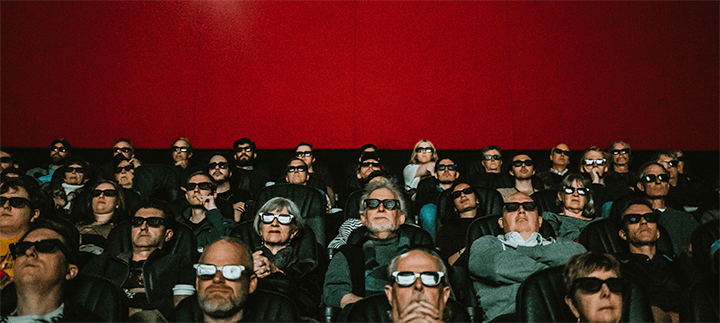
“Stereo Visions encompasses and demonstrates the full visual and affective capacities of our favorite on-again/off-again format. From Norman McLaren to Johnny Knoxville, Werner Herzog to Jean-Luc Godard, Ken Jacobs to Alfred Hitchcock, Lillian M. Schwartz to Jodie Mack, the filmmakers showcased here have been unpacking the creative potential of 3D image-making for decades, with each representing unique incarnations, moments, and impulses.” – Darren Hughes
Feature Films:
- Cave of Forgotten Dreams (2010, Werner Herzog, Polarized 3D)
- Dial M for Murder (1954, Alfred Hitchcock, Polarized 3D)
- Goodbye to Language (2014, Jean-Luc Godard, Polarized 3D)
- Jackass 3D (2010, Jeff Tremaine, Polarized 3D)
- PROTOTYPE (2017, Blake Williams, Polarized 3D)
- Seeking the Monkey King (2011, Ken Jacobs)
– preceded by Another Occupation (2011, Ken Jacobs) - Ulysses in the Subway (2016, Ken and Flo Jacobs, & OpenEndedGroup [Marc Downie & Paul Kaiser], Polarized 3D)
– preceded by Arrival of a Train 3D (1935, Louis Lumière, Polarized 3D)
Shorts Programs:
- CHROMA_DEPTH
– 3D Movie (1975, Paul Sharits, 16mm, Anaglyph glasses)
– Olympiad (1971, Lillian F. Schwartz, ChromaDepth glasses)
– Enigma (1972, Lillian F. Schwartz, ChromaDepth glasses)
– Cyclops Observes the Celestial Bodies (2014, Ken Jacobs)
– NOT AND OR (2014, Simon Payne)
– Let Your Light Shine (2013, Jodie Mack, 16mm, ChromaDepth glasses) - STRETCH_FOLD
– Twelve Tales Told (2014, Johann Lurf, Polarized 3D)
– Insight’s Cataract (2008, Willy Le Maitre, Polarized 3D)
– more than everything (2018, Rainer Kohlberger, Polarized 3D)
– 2012 (2013, Takashi Makino, Pulfrich glasses) - EXTRA_TERRESTRIAL
– Now is the Time (To Put On Your Glasses) (1951, Norman McClaren, Polarized 3D)
– Around is Around (1953, Norman McClaren, Polarized 3D)
– A to A (2011, Johann Lurf, Polarized 3D)
– All Sides of the Road (2012, OpenEndedGroup [Marc Downie & Paul Kaiser], Polarized 3D)
– Terra Incognita (2009, Kerry Laitala, ChromaDepth glasses)
– UFOs (1971, Lillian F. Schwartz, ChromaDepth glasses)
– Apotheosis (1972, Lillian F. Schwartz, ChromaDepth glasses)
– Speechless (2008, Scott Stark)