Cannes Hierarchy

Best
Certified Copy (Abbas Kiarostami)
Uncle Boonmee Who Can Recall His Past Lives (Apichatpong Weerasethakul)

Standouts
Blue Valentine (Derek Cianfrance)
Tuesday, After Christmas (Radu Muntean)
Ha Ha Ha (Hong Sangsoo)

Quite Good
Le quattro volte (Michelangelo Frammartino)
My Joy (Sergei Loznitsa)
Benda Bilili! (Florent de la Tullaye & Renaud Barret)
Young Girls in Black (Jean Paul Civeyrac)
Picco (Philip Koch)

Good
Of Gods and Men (Xavier Beauvois)
I Wish I Knew (Jia Zhang-ke)
The City Below (Christoph Hochhäusler)
The Strange Case of Angelica (Manoel de Oliveira)
Poetry (Lee Chang-dong)
The Joy (Felipe Bragança & Marina Meliande)
Lily Sometimes (Fabienne Berthaud)
On Tour (Mathieu Amalric)
Two Gates of Sleep (Alistair Banks Griffin)
Rebecca H. (Return to the Dogs) (Lodge Kerrigan)
Carancho (Pablo Trapero)
Adrienn Pál (Ágnes Kocsis)
The Housemaid (Im Sangsoo)
The Wanderer (Avishai Sivan)

More Interesting Than Watchable
Aurora (Cristi Puiu)
Film Socialisme (Jean-Luc Godard)

Decent
Udaan (Vikramaditya Motwane)
A Screaming Man (Mahamat-Saleh Haroun)
The Princess of Montensier (Bertrand Tavernier)
The Lips (Ivan Fund & Santiago Loza)
R U There (David Verbeek)
Tender Son – The Frankenstein Project (Kornél Mondruczó)
All Good Children (Alicia Duffy)
Heartbeats (Xavier Dolan)

Problems
Shit Year (Cam Archer)
We Are What We Are (Jorge Michel Grau)
Chongqing Blues (Xiaoshuai Wang)
Route Irish (Ken Loach)
Everything Will Be Fine (Christoffer Boe)
You All Are Captains (Oliver Laxe)

Big Problems
The Tiger Factory (Ming Jin Woo)
The Light Thief (Aktan Arym Kubat)
October (Daniel & Diego Vega)
The Tree (Julie Bertucelli)

Bad
Little Baby Jesus of Flandr (Gust Van den Berghe)
Lights Out (Fabrice Gobert)
The Silent House (Gustavo Hernández)


——————————————————————————————————————————-

10 That I’m Most Interested in Re-Visiting
Uncle Boonmee Who Can Recall His Past Lives (Apichatpong Weerasethakul)
The Strange Case of Angelica (Manoel de Oliveira)
Film Socialisme (Jean-Luc Godard) – with real English subtitles, please!
The City Below (Christoph Hochhäusler)
Aurora (Cristi Puiu)
Le quattro volte (Michelangelo Frammartino)
My Joy (Sergei Loznitsa)
Tuesday, After Christmas (Radu Muntean)
The Lips (Ivan Fund & Santiago Loza)
Certified Copy (Abbas Kiarostami)

Cannes Hierarchy Read More »

Cannes 2010: Day 11

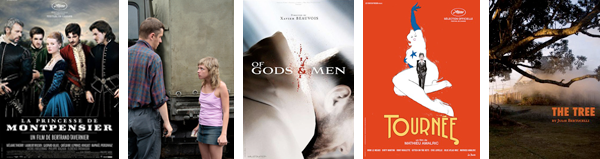
The Princess of Montpensier (Competition), and the last day begins with a loud whimper. The story of forbidden love and jealousy, inspired by an old French short story – which was itself almost certainly inspired by any number of Shakespearean tragedies – is handsome, bombastic, and occasionally rewarding, but the production is too generic and uninspired to elevate it above a typical costume dramatization of classic, and by now over-exposed, scenarios. Based on the strength of the original story, the film naturally has some effective bits and reasonably sympathetic characters, who are all decent, but, like the rest of the film, unexceptional and unambitious. Not surprising to hear that Tavernier wasn’t originally attached to this project, who seems to be making grab-bag decisions on what projects he will direct. Shrug.


My Joy (Competition), Completely different from his archival documentary style – also, notably, fictional – this film is of no less quality than the films with which Loznitsa has made a name for himself. There is a palpable dread to the proceedings of the protagonist, a truck driver who makes his way through Russia on a job, picking up and dropping off strangers, and running into some trouble. The oddly engaging journey moves at a snails pace, but the compelling performances – especially by the lead – and breathtaking camera work (not the showy kind on display by Mundruczó) support the film just fine. While the symbolism that I could sense was there was not all connecting with me, the general disdain for society, on its way to complete, hellish anarchy, will always come through, especially as it becomes more scarily relevant. This is all magnified to the nth degree when the film jumps forward in time for a truly chilling second half. The truck driver, barely recognizable now, appears to have gone mute, seemingly troubled or fed-up by a climatic run-in that closed the former half. The pacing of the film really grinds for certain stretches, and the misanthropic tone of the film grows increasingly unpleasant. The film continuously re-energizes itself just enough, though, with its intriguing structure, in which dramatic moments are interrupted by completely incongruous scenes that only become logical as they gravitate closer and closer to where we’d left off, often resulting in a violent pay-off. This is most certainly the case with the film’s closing half-hour, which stunned and rewarded me in its stone-cold proclamation that, sometimes, the worst possible outcome is the only justifiable course of action, especially in a society as fucked as this one is.


Of Gods & Men (Competition), Certainly a well-timed telling of this true event – in which a handful of French monks refuse to leave an increasingly violent Algeria (their monastery being threatened by nearby terrorist attacks), resulting in their deaths. I couldn’t completely engage with the material because it is too much a ‘really well-assembled retelling’ rather than a unique cinematic entity. The tension and looming danger arise early, and while the rest of the film (save for the finale) is terrorist-free, the threat of another, more harmful attack, is suffocating. That the monks stay even a moment after the first raid injects the film with all of the dramatic weight – not to mention potent religion/sacrifice allegorical substance – that it needs to successfully sustain itself. Unfortunately, though, the dialogue doesn’t progress from here, but only uses the inherent drama of the real-life event as a crutch. That this event is existing as cinema is never really justified other than as an easy way to make a really compelling fictional document of it. Obviously, it’s enough to create an effective thriller with some real meat for discussion – and to please critics, earning the film the runner-up award of the Competition– but, then, so was the real thing, as told in the news.


On Tour (Competition), Often dazzling, energetic, and poignant, in the end the attempts to stress the weight of family over business felt forced and hollow. Right before seeing this, Amalric was awarded with the Best Director prize, obviously for the warm and naturalistic performances that he extracted from his cast of real-life burlesque ladies, which, admittedly, sometimes fall flat. The film is best when the girls are either performing campy, soulful numbers, or having random, catty conversations in their traveling hours. The film seems to balance, though, on the fact that Amalric’s character, the touring manager, is timing their tour to hit Paris so that he can meet up with his sons who he never sees, which for some reason displeases the girls, which misguidedly calls upon certain acting skills that they clearly lack. Still, though, hold-ups aside, the quality bits here are really impressive; the kind of work I didn’t expect Amalric could (or even wanted to) pull off.


The Tree (Closing Film – Out of Competition), A young father has heart attack, or something, while driving, and rams his truck into his family tree and dies. His spirit is inhaled by the tree, which talks to his daughter, and maybe his wife, possibly. No, this isn’t a sequel to The Fountain, nor is it the awesome B-movie it may sound like. It’s pretty genuine and awful. But at least Gainsbourg is in it, a long way off from the bravura role in Antichrist, playing the kind of character that Miley Cyrus will likely excel at when she’s ten years older. Did I mention that the tree ends up swallowing their house during a storm, ala The Poltergeist? An awesome way to end the festival.


More Cannes Coverage:

Day 1, Day 2, Day 3, Day 4, Day 5, Day 6, Day 7, Day 8, Day 9, Day 10, Day 11

Cannes 2010: Day 11 Read More »

Cannes 2010: Day 10

Tender Son – The Frankenstein Project (Competition), What starts promisingly enough eventually relishes in style over substance, serving as a demo reel for Mundruczó’s talent with the camera more than any ability to craft interesting characters or engaging drama. The film introduces us to a filmmaker who is holding an audition for a few roles in an upcoming film, and a young man shows up for an audition who seems completely uninterested in acting. After the director has deployed his usual tactics for squeezing performances out of non-actors, the boy loses his cool on fellow auditionee, igniting a witch hunt. It’s easy to get absorbed into the set-up, but after the first half-hour, it never delivers beyond, like I said, the occasional bravura cinematography. Some violent scenes littered throughout the running time have an ‘oh damn’ factor, and the filmmaker who was holding the auditions makes a late return to restore hope that we might get to see every character die.


Route Irish (Competition), I’ve had a grudge against Loach ever since the utterly mediocre Wind That Shakes the Barley took home the Palme four years ago, but that cannot be used as an explanation for how completely bored I was by this generic political thriller. Not a single sympathetic character can be found in this shouting match between Mark Womack and everyone else. Having no real drama or catharsis at all, this is just another failed Iraq film that ends up celebrating violence in its misguided ‘critique’ of war.


More Cannes Coverage:

Day 1, Day 2, Day 3, Day 4, Day 5, Day 6, Day 7, Day 8, Day 9, Day 10, Day 11

Cannes 2010: Day 10 Read More »

Cannes 2010: Day 9


Lily Sometimes (Directors’ Fortnight), While this comes a bit too close to The Other Sister territory to be more than a guilty pleasure, Berthaud’s style and direction, as well as the lovely Diane Kruger, are just as potent as in their previous meet-up in Frankie. Two sisters, whose mother dies in the opening scene, struggle to get by, mainly because Lily, the obnoxiously compulsive younger sister, seems borderline mentally unstable. While Lily scurries through the wild in skimpy gowns with frazzled hair, having orgies with random boys in the woods, her uptight, married sister, Clara, chases her around, trying to maintain her behavior while pleasing her even more humorless beau. The film’s best scene shows Clara getting fed up with Lily and nearly offing her; the outcome of this is just as much a relief as it is a disappointment. Not to fear, though, Lily shows big sis the ways of the wild, forging a promiscuous liberation that is as feel-good as it is repugnant and contrived. Strange that this won the sidebar.


Uncle Boonmee Who Can Recall His Past Lives (Competition), ended up being (just about) what I’ve been waiting all week for. First things first, this was not as immediately satisfying as Syndromes and a Century, and in the first half I was finding myself getting frequently annoyed that Weerasethakul was doing things which were alarmingly predictable coming from him (illness, ghosts, folklore, cheesy Thai pop songs). Not that any of it is any less enrapturing than in his previous films, but the familiarity was a bit of a let-down, and almost enough to make me uneasy. But, this is also, notably, the first time I’ve gone into a Weerasethakul film with the kind of astronomical expectations that are always impossible to satiate. I saw Tropical Malady before Syndromes, and while I was certainly, by that time, a fan of the former film, there was still an unknown as to what he was capable of, allowing the latter film to blow my mind without any foreshadowing of what was coming. By the end of Uncle Boonmee, though, this was more or less put to rest.

Boonmee further develops what seems like it will always and forever be Weerasethakul’s primary theme in his oeuvre: reincarnation; not just in the Buddhist and spiritual sense, but also in cinematic and political ones. His previous films have had bifurcated structures that emphasize a repetition/evolution/deviation in the roles and scenarios which reflect and distort one half from the other. Often, though, this aspect of uncanny repetition is also exhibited from film to film, not just limited to the two halves of a single film. One of the accompanying shorts in the ‘Primitive’ project, A Letter to Uncle Boonmee, makes this almost explicit, when the wandering camera settles on a water buffalo right next to the tree from the climatic scene of Tropical Malady, in which nature and ideas are reincarnated in a completely different context. Another illustration of cinematic reincarnation is seen when the same actors appear from one film to the next – Sakda Kaewbuadee playing the young soldier and tiger in Tropical Malady, then a monk in Syndromes, now a monk again in Boonmee – evoking similar mannerisms and character traits from past films (lives). The same applies to Jenjira Pongpas, who first appeared in Blissfully Yours before reappearing in Syndromes and now Boonmee, carrying her limp from film to film. Of course, her limp and Pongpas’ monasticism (as well as his military service from Malady) borrow from their real lives (or, at least, their current lives) in which these scenarios are actualities. Reincarnation, actually, is perhaps the most apt metaphor for the phenomenon of role-changing in which actors engage.

Also notable here is that politics have come further into the fore than in the past. I got less of a visceral jolt from Boonmee than its two predecessors, but certain moments and themes – the monologues of cultural extinction, ‘beasts’ in captivity, and news-watching gone sci-fi – clearly relevant to the present political climate of Bangkok (and, unfortunately, many other places) left a lingering eeriness and mystery that Weerasethakul has become an expert at suspending. Leaving ample room to mix and match character/animal/insect relations, as well as timelines, Uncle Boonmee is a singular cinematic puzzle.


Rebecca H. (Return to the Dogs) (Un Certain Regard), Speaking of cinematic puzzles, not a soul in Cannes knows what the hell Kerrigan was thinking of with this baffling project. Reading like an aborted biopic on Jefferson Airplane singer Grace Slick that was assembled anyway, the film combines aimless scenes of Géraldine Pailhas walking, scene rehearsals, on and off-set drama with Kerrigan himself, allusions to a pregnancy, and pretty cool footage of Pailhas trying to imitate Slick’s singing voice for the film (or whatever it is). As would be expected from something like this, there is an iciness in the air that makes the filmmaking process look like a dive into hell (not far removed from the tone of INLAND EMPIRE). I like the stream-of-consciousness of it all, but if I’m going to look at a dissection of the working process and interior ramblings of a filmmaker, I would hope for a better subject than Lodge Kerrigan.


The Tiger Factory (Directors’ Fortnight), I’m less inclined to post much of anything on this film because for about twenty minutes in the middle of the screening the English subtitles went out of sync by about a minute (this was at the official premiere, and the producer had to leap out of his chair to get the projectionists to fix the problem), but this happened over an hour into this dire, miserable mess; the only film that I contemplated walking out on. The film is about a girl, who makes a living jerking off pigs and shooting the cum into mama pigs, who is pregnant herself. She has her baby, which is immediately pronounced dead and carried away. A whole lot of ‘not much’ happens before a late twist gives the film a hint of purpose, but it was a serious case of too little, too late.


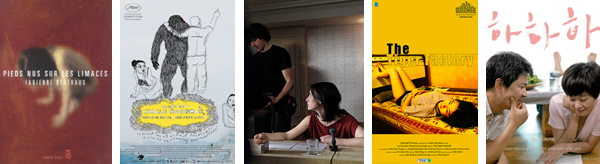
Ha Ha Ha (Un Certain Regard), I’ve only seen four of Hong’s films now, but I totally ‘ha ha ha’ed at this one more than any of the others. My lack of exposure to the filmmaker is probably fortunate, based on the claims that his films are all basically remakes of the previous ones, because everything felt very fresh for me. Apart from being just a really sharp rom-com, the film is structured around an intriguing set-up (two friends meet up after not seeing each other for a while and talk about their girl troubles) that gives the film some tension (the audience quickly learns, through the fact that we get images to accompany the conversation, that the two friends’ girl troubles, unbeknown to them, involve the same girl). Though this scenario doesn’t lead to the anticipated epiphany that one would expect, the film has so many turns and developments (probably too many, actually) that I wasn’t left feeling like anything was missing. Not much to say to say more than it’s a really well-observed relationship study with hilarious, often dense characters.


More Cannes Coverage:

Day 1, Day 2, Day 3, Day 4, Day 5, Day 6, Day 7, Day 8, Day 9, Day 10, Day 11

Cannes 2010: Day 9 Read More »

Cannes 2010: Day 8


Poetry (Competition), surprisingly reminiscent of last year’s Bong Joon-ho film Mother, Lee’s elegant film never lives up to the promise of its set-up. The film takes a look at a grandmother who, upon learning that she has Alzheimer’s disease, which is making her forget certain words, decides to take up learning how to write poetry. In a parallel plot, her grandson, who lives with her, has been named as one of six possible perpetrators of an unspeakable crime. The film is drawn-out with a leisurely pace that suits the proceedings rather well, but my main problem is that the two plots can’t find a way to wrap themselves together in any sort of meaningful or satisfactory way, remaining separate until a last-minute effort to tie the film together is as poorly written as it is extraneous and, ultimately, unnecessary. The poetry-writing, which could have been shown in any number of interesting ways given the protagonist’s disability, is rarely looked at with more than a 101 looking glass, and is not even noticeably hindered by the fact that the woman who is learning it is losing more and more words from her vocabulary every day. Perhaps I was too influenced, and thus disappointed, by my own hopes for how the intriguing scenario would materialize, but I have to say that, even with the deviation from my expectations, it offers little chew on after the credits start rolling.


Lights Out (Un Certain Regard), The name Agnes Godard showing up in the credits is the only reason I can come up with as to why something like this could end up in Cannes rather than living out a two or three-week run at the multiplex before gracefully disappearing into crap-movie oblivion. The movie centers around the disappearance of a high school student named Simon Werner (the French title for the film translates to the much more evocative title Simon Werner is Missing…), and focuses on 4 or 5 characters who were affiliated with Simon in some way. One by one, we follow each character leading up to Simon’s disappearance, and the climatic hunt for him one night during a party. Even though this vaguely intriguing premise has been done before, most recently in Elephant, the real trouble is that every character in the film is only a generic and superficial representation of a different high school stereotype. Pompous jock, check. Popular pretty girl, check. Artsy girl with dyed hair, Nerd with glasses and eccentric father, Submissive best friends to jocks, check, check, check. Not to mention that the supposed emotional pay-off for the film centers around a character who we only see briefly, being an asshole, and his five or so friends who also lead unsympathetic existences. Not far off from Dawson’s Creek.


The Joy (Directors’ Fortnight), This indescribable film got one of the worst receptions of the festival, which is too bad, because for all of its flaws, it was one of the more risk-taking and intriguingly experimental narratives that I’ve seen this year. I was often reminded of the Larrieu Bros.’ awesome Les Derniers jours du monde from last year’s Directors’ Fortnight, with its anarchic and viscerally dizzying portrayal of society on the brink of apocalypse. Much of the running time follows a handful of teenagers who run around an empty Brazil in animal or jungle costumes, or naked, sometimes acting like zombies, avoiding unseen armed forces who could shoot anything, at anytime. Because nothing very definitive ever actually happens, it’s clear that what is going on at any given moment is not as important as just absorbing the dystopian lives and carefree rhythms on display, which is often enough to satisfy. This is apparently the middle film in a trilogy, which is pretty annoying.


Picco (Directors’ Fortnight), The most provocative film I saw at Cannes this year, I wish this had been placed in Competition, if only to spice things up a bit over there. The film is a brutal representation of supposedly true events that took place in a German youth prison some years ago, in which two tough guys force one of their two cellmates to help them torture the other cellmate in an attempt to get him to commit suicide. While the first half of the film is a casual examination of life in the prison, complete with cigarette trading, chores, and rapings, the latter half sees the slow meltdown in this particular cell with the main four cellmates that is extremely difficult to watch at times. The film is painfully real and claustrophobic, but in the end, the more and more recurrent question with this kind of violent film is the lingering thought: How much is too much? With rapings, beatings, torturing become more and more common and gruesome in the cinema, can anything be justified? There is very little joy in watching something like this play out beyond technically admiration, and while I can’t say for sure that it brings something new to the discussion of violence in the cinema, I can vouch for a compelling and memorable viewing experience that is impossible to be indifferent toward.


More Cannes Coverage:

Day 1, Day 2, Day 3, Day 4, Day 5, Day 6, Day 7, Day 8, Day 9, Day 10, Day 11

Cannes 2010: Day 8 Read More »

Cannes 2010: Day 7


You All Are Captains (Directors’ Fortnight), the film opens with a young man and his partner, presumably both filmmakers, detailing the mechanics of a camera apparatus – how the device inhales reality, flips and inverts it, to record an image on emulsion. This demonstration is being done for a room full of what appears to be school children around age 10. Shot entirely in black and white, the directed pedagogy and presumed naivety of the children make one immediately think of early Kiarostami work, especially shorts like Two Solutions For One Problem. This demo is taking place, we find, because the kids are going to be given cameras to go around town to film the troubled lives they lead. After learning that the kids aren’t ‘ordinary’ school children, but ‘underprivileged’ ones, the uneasiness that we feel in this poorly-thought out, exploitative experiment is also felt by the children, who rebel against Laxe, the director. From this point on, the project only falls further apart, because the kids will not cooperate with this man who they do not trust – a man who shows, on camera, that he doesn’t know how to win over the trust of, much less direct, children. I imagine that many will find interest in this as a study on the pitfalls and difficulties of working with children, but when the documented man who cannot work with his actors is the same man who is making the film that I am watching, I very quickly wish I was just watching a film by someone who does know how to direct child actors (like, for instance, Kiarostami). It’s no secret that children are difficult to work with, nor that they will reject someone who disrespects them; this also applies to your film’s audience.


All Good Children (Directors’ Fortnight), A momentarily lovely film about adolescent loss and lust – beautifully filmed by Duffy, and warmly acted by the young cast – has too shallow a focus to avoid spiraling completely out of control into an absurd and laughable thriller. My memory of this one has become pretty hazy pretty quickly, but think The Secret Garden meets The Good Son for an idea of what Duffy brings to the table here.


Certified Copy (Competition), ***Knowing anything about this film is a spoiler. While I’ll keep this capsule Spoiler-Free, I think that reading a basic synopsis, or even viewer reactions, before viewing this minor masterpiece is a bit of a party-pooper.***   I ended up seeing this again today, after attending the public screening yesterday, because of a scheduling mix up (I actually thought I was in line for Of Gods & Men, oops!), but it ended up being a very happy accident, as I got to see my favorite film of the festival a much-needed second time.

Within the opening minutes, I was already catching things that were making me completely re-evaluate the roles of the major characters in the film (and these roles are still anything but nailed down for me, even after seeing it twice). The film has a strikingly similar set-up to (and will often be compared with) Before Sunset: a book release brings together two people who then spend the rest of the movie talking about art, philosophy, and relationships. But there is a very interesting twist that happens, one that kind of eases its way into the dialogue in a way that it is, at first, almost imperceptible; one that forces the viewer to question all of the conversations and mannerisms and meetings that took place before. The role-playing games really take off from here, and the results are, perhaps misleadingly, occasionally off-putting, even if they are always fascinating. The acting styles from both Binoche and Shimell are in a constant state of flux between naturalism and excessive Romanticism and cringe-inducing hamminess, to the point where, during the first screening, I actually reconsidered Binoche’s acting abilities altogether (“maybe she’s only effective when masked behind French dialogue?”, I thought). And this isn’t even touching the levels that Shimell approaches, with an awfully performed scene in an Italian restaurant in which he loses his cool and goes on a rant about wine-drinkers, newly-weds, and Elle (Binoche), all of which is so over-the-top and poorly written that I was, on both screenings, starting to lose faith in Kiarostami’s vision.

But, these few bits that I would call ‘low points’ have enough of a hint of intentionality that it never get derailed. Certain questionable moments are left open enough that they will likely be points of debate for years to come. This is especially supported by the fact that a ‘terrible scene’ will often be followed by a gut-wrenching, spot on one that nails everything; I chuckled at how effortlessly Kiarostami was having his way with me. And above all, like the best of his work, this film has a Heart, even if it isn’t always felt. This is clearest when the film’s final moments come, which are as mystifying as they are heartbreaking as they are beautiful, ending with a closing line – once again throwing me off of a previous scene in the film that I thought I had nailed down – which is still ringing in my ears, choking me up, while I struggle to figure it out.


October (Un Certain Regard), If you like films where a grumpy misanthrope is forced to care for a baby, struggles with caring for the baby, tries his damnedest to get rid of it, then finally warms up to the baby and realizes that it only took one innocent soul to show him that life is not so bad, then this is the film for you, and may our paths never cross. (though to be fair, the film has a scene that works, in which a roomful of the guy’s ‘friends’ sardonically sing him Happy Birthday and then blow out his candles for him)


Udaan (Un Certain Regard), While I can’t say that I welcome this year’s Slumdog Millionaire with open arms, at least this tale of a down-and-out boy finally rising above a lifetime of trials, tribulations, and a bastard father doesn’t have a clear-cut route in its manipulative plot, and doesn’t drag its audience through blood, shit, and piss in order to convince us that this guy deserves a break. I think there would have to be a major break-through or revolution in Bollywood cinema for the industry to actually produce something that I would want to see more than once, and that certainly still applies to Udaan, which is over-long, one-dimensional, and trite. But it is quite a bit of fun, and, in some parts, surprisingly ‘gritty’ and realistic, suggesting genuine dangers for our hero. That said, it won’t win Best Picture, and will therefore live on, just as Slumdog should have, as a slightly-more-entertaining-than-usual blip on the radar.


More Cannes Coverage:

Day 1, Day 2, Day 3, Day 4, Day 5, Day 6, Day 7, Day 8, Day 9, Day 10, Day 11

Cannes 2010: Day 7 Read More »

Cannes 2010: Day 6


Two Gates of Sleep (Directors’ Fortnight), Five minutes in, it crossed my mind that I might be watching the beginning moments in the career of a very gifted student of the schools of Malick and Tarkovsky; Griffin certainly lets it known, both in interviews and in his styling, who his heroes are. That Gates doesn’t live up to the promise of these opening minutes is both unsurprising and disappointing, mainly because, very intermittently, the ability seems to be there. This project’s ultimate downfall – which is common for films with this kind of ambitious search for an epic, quiet, nature-dwelling godliness – is that it becomes so precious, and so desperate for poeticism, that it auto-asphyxiates, blocking out any and all emotion or life. The sound design and photography are aces, and I think that Griffin and I would have a lot of overlap in our DVD collections, but, like Dolan, it is apparent that he wants to be his idols, rather than showing a reason to be amongst them. At least for now.


Certified Copy (Competition), see Day 7 write-up, in which I saw this a second time.


The Lips (Un Certain Regard), I like the flow and, forgive me, ‘focused aimlessness’ of Lips, but I cannot for the life of me figure out what in the world this film was trying to do, nor if it is completely fiction, completely doc, or both. My confusion is probably not entirely unintentional, nor completely the film’s fault, and I do not have a displeasurable memory of it (I actually had a similar, dazzlingly frustrated feeling while watching Our Beloved Month of August, for what it’s worth). Are these women acting out real interviews with real people, but in character? And what about the men who ogle them when they are all dolled up in their off hours? The press notes could tell me, but I’d prefer another look.


Young Girls in Black (Directors’ Fortnight), As one-dimensionally angsty as this film about two suicidal goth stereotypes often is, it somehow manages to be quite relaxing and enjoyable to watch. Like Civeyrac’s previous Through the Forest, it has a brooding dreaminess, that is not far off from how I remember feeling when I was a teenager watching The Virgin Suicides for the first time, that somehow connects to the nostalgia of being young without forgetting that it is often a scary and alienating mess. While the girls, obnoxiously, are typical Hot Topic anti-social butterfiles that everyone in high school always suspects will take their own lives, the film wins major points in the way it depicts the family life that they live in, which is cautiously jovial and kinetic, fully aware of the girls’ fragile states, while also being genuinely loving to the point where it is both baffling and understandable how they might have developed into these kinds of girls, who aspire to the heroic aspects of suicide. The film, which isn’t as ironic as the title might suggest, takes an interesting turn at the 2/3 point that unfortunately doesn’t really know where to go, but the last impression is still one of a breath of fresh air in a genre that is very often drowned in too-serious, pointless murk.


Blue Valentine (Un Certain Regard), I’m a little embarrassed to say, I guess because it has such a Sundance-y, Amerindie vibe to it (including a damn (and damn gorgeous) Grizzly Bear score), that I got more out of this than I did from Maren Ade’s, also affecting, recent break-up movie. But, alas, the inevitable second half of this (debut(!)) film was absolutely crushing. However, I do wish, for both this and Everyone Else, that the deterioration of their respective couplings were less black & white in their presentations (Valentine mixes the first few months with the last few days of its relationship, which of course will be only the most insanely blissful moments juxtaposed with cringeworthy ugliness, while Everyone Else‘s pair goes from seemingly fine to immature assholes almost at the flip of a switch). And while Valentine doesn’t seem to do much more than state the obvious – a relationship that is held together by, and whose raison d’être is, mutual physical attraction, is a ticking time bomb as middle age takes over, unfairly hitting one partner before the other – the performances by Gosling and Williams make the disintegration of a completely average and banal pair of individuals feel unrelentingly tragic.


More Cannes Coverage:

Day 1, Day 2, Day 3, Day 4, Day 5, Day 6, Day 7, Day 8, Day 9, Day 10, Day 11

Cannes 2010: Day 6 Read More »

Cannes 2010: Day 5


Film Socialism (Un Certain Regard), as much as I would love to be one of those guys that can support anything Godard makes, I’m just not one of those guys. I don’t like having a finger wagged at me for only speaking English, which is exactly what this version of this film did, giving me a handicapped cut that is just as indecipherable as, well, any unsubtitled film will be if you do not speak the language. Strong visuals don’t make up for this. Many will defend the decision for ‘allowing’ us to watch the film for body language and its unique visual look, but there really isn’t much going on in that department that Godard hasn’t already been exploring for well over a decade: the plasticity of the video palette – a palette of over-saturated, sometimes crystal-clear, other times hyper-pixelated, imagery – and, of course, a soundtrack that drops out and swells awkwardly to underline that we’re watching a product that is synched and polished in post-production gimmicks. But how can I not feel short-changed when I am being deprived of language, when I know how key word-play is in Godard’s work? Would anglophone cinephiles be ok if there weren’t English subtitles for theatrical screenings of Breathless? One’s answer to that question will go a long way in determining how much one will like Film Socialism, a Godard film that, once again, tells me more in its plot synopsis than in my viewing of it. No Comment.


Carancho (Un Certain Regard), see the thumbnail of this film’s poster up top? Carancho is a really well-made version of exactly the type of film that that poster suggests it is. If you like really good episodes of prime-time crime dramas, with a twist of Crash (I would specify which one, but, for what it’s worth, it really could be both), this will satisfy.


The Wanderer (Directors’ Fortnight), Slow-burning and engaging enough to be mildly rewarding, but that it all culminates in the button-pushing scene that it does makes the entire film feel too calculated to provoke. Certain circumstances had every male in the audience squirming, feeling a bit of a ghost pain slightly below the waist, which are really the film’s most effective bits. It is here where the sensibilty is that ‘everyone would hate to be this kid’ before we end feeling that ‘everyone hates this kid.’


Everything Will Be Fine (Directors’ Fortnight), Everything is fine, at least for the first act, where the film has a pretty damn well-crafted sense of paranoia and dread draped over every minor decision that every character makes. The government can be scary when they really want you to keep your mouth shut. Add in strange developments about the protag’s looming deadline for a script that he’s writing, and his trouble with remembering to sign some papers to adopt a kid, and you have me pretty damn intriqued. Shame on me, because what it all adds up to is unimaginably lame, it truly is something (I’m sorry, but I’m just going to have to tell you: the whole film is the screenplay he’s writing (duh), which is being channeled through the fact that, I’m not kidding, his wife DIED because she was furious that he made a mistake on their adoption application that would have resulted in an, omigod, 2-week delay in finalizing their adoption a kid). But who am I kidding, I strongly recommend everyone see this film, and then come talk to me.


A Screaming Man (Competition), Did you hear! there’s a movie from Chad in the Competition line-up this year! I know right!? Chad, of all places! (but really, this was as dull as my cub scout pocket knife. A film from a country that we don’t often see films from does not make the film any more inherently interesting than any other films. Not only can this father/son feud’s outcome be seen by at least the halfway mark, but I couldn’t care less for anyone, nor comprehend many of the bizarre decisions that they made. I hear Dry Season is good, though.)


More Cannes Coverage:

Day 1, Day 2, Day 3, Day 4, Day 5, Day 6, Day 7, Day 8, Day 9, Day 10, Day 11

Cannes 2010: Day 5 Read More »