Author name: Blake Williams

DVD: Close-Up (Kiarostami, 1990)

Again another masterpiece. The last two films I’ve seen by Mr. Kiarostami, I’ve pushed the play button with a slight anxiety that I will finally be treated to a film by him that is only just ‘good.’ But my fears were alleviated with brevity as it only took a few minutes for me to become completely engrossed in everything about this film. The idea behind the story in this film is quite similar to the recent Colour Me Kubrick. I’m almost convinced that that film is at least an homage and borderline plagiarizing the event that is depicted in this one (There are probably interviews with the filmmakers of Kubrick in which they cite Close-Up‘s influence, but I’m too lazy to look). In both Kubrick and Close-Up, the protagonists pretend that they are well-known filmmakers; John Malkovich portrays Alan Conway who pretends that he is the reclusive Stanley Kubrick, and Hossein Sabzian (portraying Hossein Sabzian) pretends that he is Mohsen Makhmalbaf, director of The Cyclist. Where Kubrick was a fictional account of a true story that emptily narrowed down Conway’s motivations to narcissism, boredom, and laziness, Kiarostami’s film is a subtle and complex study of the nature of fiction.

Sabzian’s brief life as Makhmalbaf is a true story; in fact, every single person seen in Close-Up other than Kiarostami is playing themselves and acting out the actual events as they happened. If they are leaving information out of the reenactment, they fooled me, because this is an incredibly detailed account of the days that Sabzian fooled and housed with the Ahankhah family. The film is intercut with actual footage that Kiarostami shot during the trial in with the Ahankhah family attempted to prosecute Sabzian. The film, like all of the Kiarostami’s that I’ve have seen so far save for Where is the Friend’s House?, takes a while to grasp in terms of what is fiction and what is non-fiction, and just how many layers of reality are being depicted. I think that one could argue that the entire film is fiction with someone who thinks that everything in the film is non-fiction, and both would probably be just as right and wrong as the other.

I love to imagine the production of this film, and how awkward it must have been for the Ahankhah family to film scenes with Sabzian after feeling so betrayed by him. An exaggerated example of this is if a filmmaker wanted to make a fictional film of the Monica Lewinsky scandal, and cast Bill Clinton as Bill Clinton, Hillary Clinton as Hillary Clinton, and Lewinsky as Lewinsky. The audacity of the idea is so good that it feels too good to be true, yet it is. The film ends with a typically moving moment of redemption and forgiveness. I haven’t seen a short or feature length film by Kiarostami yet that hasn’t ended with me somewhere between emotionally flustered and tears welling up, and none of these reactions are from sadness, but simply from blissful happiness.

DVD: Close-Up (Kiarostami, 1990) Read More »

DVD: Milk (Van Sant, 2008)

Gus Van Sant is one of the most night and day filmmakers that I am familiar with, creating feature films and shorts that I can’t find a middle ground on, I either love them or hate them. It’s a great relationship to have with a filmmaker, because I know when I see something by him, I know that I will come out of the experience with a passionate reaction to what I’ve seen. After his mainstream Good Will Hunting, Psycho, Finding Forrester trifecta, I thought I was done with him. Especially since I didn’t share the praise for My Own Private Idaho that so many others have, I didn’t see any reason to continue paying attention to him. And then his Death trilogy happened followed by Paranoid Park and he made this impossible turn-around that was so out of the blue. He went from movie-of-the-week Oscar seeker to some kind of godson of Bela Tarr. I’m suspicious of the abrupt transformation, but I’m certainly glad that it happened. So when Milk was announced I was ecstatic to see how he would apply his new cinematic techniques to this kind of a film. The trailer was eventually released and reviews began coming in and all signs were pointing to a return to his 20th century form. I lost interest in the project and pushed if off of my radar, as I’d lost hope that it would have anything worthwhile for me. There are two genres in film that I have trouble forcing myself to be interested in (beside traditional Hollywood junk): political thrillers and biopics. There is something silly about a Hollywood celeb dressing up as a well-known figure and acting out his Wiki page or recreating something that should be a documentary instead of fictional non-fiction. There are filmmakers who play with fiction and non-fiction in formally interesting ways, but biopics and political recreations are just a kind of candied version of the truth for people who are too ADD for the real thing.

So anyway, I was hesitant to see this film when it was released, and I certainly wanted to see it far enough after Proposition 8 so that my feelings toward the film wouldn’t be swayed too much by that. I think it’s important to forget concurrent real life events that relate to a film when watching it, like talking about Wendy and Lucy and the economic crisis as if the film is a response to these ‘tough times.’ Neither of these films was made with these issues in mind, so I think it’s unfortunate that I have to watch them in circumstances that cause me to think about things that the filmmakers weren’t intending for me to think about. Prop. 8 does help me contextualize the battle against Prop. 6 recreated in Milk, but like I said, I wish I didn’t have a contextualization other than the film itself.

I thought Milk was pretty great, as good as it possibly could have been given its format and subject. Sean Penn was a revelation for me, I’ve never liked him in a film before, but he characterizes Harvey Milk as such a sweet and important man I couldn’t not wish that the film would end differently than it was going to. The film managed to make me forget that it was based on history, a plus, and I was able to become absorbed in the characters personal decisions and relationships as if the outcome wasn’t already determined. When Harvey and Scott split, it’s pretty tough to take, and the lover that Harvey has after him feels inferior simply because he isn’t Scott. I could praise every actor individually, but it’s been done already all over the internet, so I’ll just say that everyone in this is the best that I’ve ever seen them.

I don’t think it was good when, at the end of the film, they show photos of the main characters in the film, first the actor dressed in character, and then a photo of the actual person. All of the real life photos revealed just how dolled up and attractive the film made them, reminding me that the film partially exists to make money based on its stars and sex appeal. Should the gay community be interested in this because James Franco looks like a hunk and has his shirt off a lot, even if the real life Scott is not that easy on the eyes? or that all of Harvey’s staff look like the cast of That 70’s Show? I could have suspended the illusion just a little bit longer than the credits. But anyway, it’s an important film about an important man, and the main point is that as many people as possible know about him and what he did and how things aren’t so different now than they were in the 70s. The Oscar season has already tossed out any illusion that they intend to honor the bests films of any year, and have instead latched onto an idea that their decisions will be political statements. The idea that Slumdog Millionaire is the Best Picture winner, therefore I guess considered more important than Milk, is embarrassing and idiotic.

DVD: Milk (Van Sant, 2008) Read More »

DVD: The First 4 Films of Bruno Dumont

La Vie de Jésus (1997)

The title of Dumont’s debut suggests an examination of spirituality that I didn’t get from the film, suggesting either irony, pretension, or that I am immune to spirituality in films (could be the case, ie. my lack of appreciation for Davies and Bresson’s work). I liked this film, despite not agreeing with the title. The film focuses on a group of racist doofuses (doofi?), including the protagonist Freddy, and Freddy’s girlfriend Marie, who is being pursued by an Arab boy in town. The way that the plot unfolds is pretty predictable, but Dumont’s lulling style kept it interesting for me, and the abruptly graphic sex scenes do provoke… something. Freddy and Marie have aggressive sex inside and outdoors, seemingly moving it out into the wild to better frame the somewhat animal portrayal of their fornication.

The sex in this film is so unarousing that it magnifies the fraudulence of many art films that claim to have sex scenes that are unarousing, scenes that are there for the progression of the ideas in the film or for ‘art’s sake’ (Breillat came to mind). Dumont lenses the sex scenes as if he were filming cow sex. His characters seem to approach their sex in the same manner that I contemplate checking the mail: I kind of look forward to it, I do it every day, it only takes a few seconds, and I ultimately get no satisfaction out of it. Dumont sheds these characters of the minimal physical attraction they have in these scenes with unflattering close-ups and angles of parts of the body that even fit people usually try to conceal. The effect of these scenes is that I interpret the characters actions on a more innate and animal level. Murders and rapes come off as products of human nature, a sense to protect ones territory and invade the territory of others, rather than simply disturbed morals. The characters in this film are ugly people, and they make me feel a little bit more hopeless for mankind.
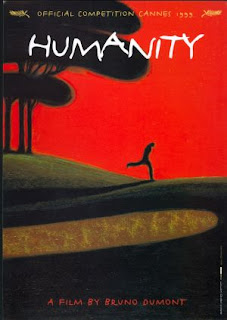
L’Humanité (1999)

Picking up where Jésus left off, L’Humanité could very well be focusing on the cop perspective of the previous film. Pharaon opens the film running through the hills of rural France, disturbed by something. He is soon revealed to be a member of the police, and then I was abruptly thrust into an investigation of the rape and murder of a young girl via a shot of her rotting vagina crawling with ants. The body seems to be in the same grassy field, covered maybe with the same ants that were crawling on Freddy, in the closing moments of Jésus. Though I was watching the ‘good guy’ perspective of a crime this time, the film has the same grimy mundanity of Dumont’s debut, and Pharaon’s neighbor and friends Joseph and Domino have the same sort of semi-abusive, territorial relationship that Freddy had with Marie. This film is doing more interesting things formally than Jésus was, though, and its pessimistic study of a man’s perception of humanity feels somehow epic.

The film is doing a lot of confusing things with the crime investigation genre that seems arbitrary to Dumont’s greater goals (much like his exploration of the horror genre in the consequent Twentynine Palms), but it did have me more engaged in the events than I was with Jésus. The meat of the investigation isn’t even introduced until well into the film, perhaps close to an hour into it, and the entire case disappears for long stretches of time and circles itself as if it wasn’t written by the same writer. Interviews are held with people for the sake of interviews, and the entire city seems to be sleepwalking in the aftermath of the tragedy.

Pharaon is the most complex, bizarre, and wonderfully conceived character in any of Dumont’s films so far. He has a naive holiness that makes me understand the Bresson comparisons a bit more than I did after Jésus, and it makes his relationships with anyone, especially Domino, have a tension and an emotion that is lacking in the other three films by Dumont. When Domino leaves Pharaon after they arrange to have dinner for the first time, Pharaon’s giddiness and physical elation is comparable to Adam Sandler’s dancing through the aisles of the dollar store in Punch-Drunk Love. He is awkward and pathetic and sad and genuinely cares for the good in people.

Spoilers — Dumont, showing that he can end his films with the best of them, closes the film with a kind of Silent Light-ish kiss of redemption. Pharaon had always threatened to inappropriately land a wet one on an unsuspecting person, and it goes over the edge at the end here with a shocking and blunt kiss where he seems to be trying to suck the sins out of Joseph. When the film closes with Pharaon in hand cuffs, I felt slightly cheated that Dumont ended the film with a silly and unnecessary ‘open-to-your-interpretation’ cliff hanger. However, after thinking about it a bit more, I think it’s okay, and I came up with a few versions of the ending that I’m not annoyed with.

Twentynine Palms (2003)

While I felt less enjoyment watching this than I did while watching La Vie de Jésus and L’Humanité, my thoughts at the end of it were leaning toward this being Dumont’s tightest film. For most of the running time, I had narrowed the film’s accomplishments to being a very elaborate and well shot Hummer commercial. What begins as a Hummer commercial, though, switches gears in the final twenty minutes, and becomes inarguably favorable to the Ford F-350 crew cab. The automobile metaphor is almost as explicit as the nudity and sex scenes, and half-way through I kept thinking to myself ‘okay, I get it.’ Katia, a French bimbo tagging along with her boyfriend David on some sort of getaway to Twentynine Palms, cannot drive. I guess her inability to operate the oversized vehicle is a way of showing her God-given incapability of handling an SUV (as offensive a metaphor as the actual Hummer commercial that suggests that men who eat tofu and eat healthily should buy a Hummer so that they can feel like men again). When she attempts to drive, she steers the slow-moving gas guzzler into bushes and cacti, scratching the paint job and upsetting David. Katia, pretty but a complete airhead, can’t do much of anything, actually, other than provide a hole for David. It was difficult for me to feel sympathy for her, even when the relationship gets abusive toward the end. David is even less likable than Katia, showing insufficient patience for Katia’s weakness in English and throwing temper tantrums that become more and more over-the-top and ridiculous toward the end of the film; the lack of a sympathetic character was the downfall for much of the film for me. However, I felt that the explosion of violence and plot at the end made sitting through the rest of it worthwhile, similar to how the end of The Brown Bunny redeems the tedium of the rest of the film (that film actually has several things very much in common with Twentynine Palms, including as the desert setting, endless driving, and explicit sex).

In Dumont’s films, women are the more dynamic characters, while the male characters all seem to be the same abusive, conservative honkies (save for L’Humanité‘s Pharaon). David is somewhat of a break from this type, in the sense that he seems (for some of the running time) to have a respect for a woman’s ability to think. He also is in a higher class than Dumont’s other male characters, has a decent job, and can at least afford a Hummer and an occasional vacation. That he evolves so abruptly into such a heartless beast is what made the end of the film so unsettling. While Dumont’s other males were somehow believable as rapists and murderers, David’s transformation is the only one that I can say I didn’t expect. There is a useless epilogue that makes up the final scene of this film and doesn’t work at all, ruining the disturbing images of the previous scene. I don’t know what Dumont was thinking when he scripted this, but it began as irritating and eventually came off as an attempt at comic relief. Other than that epilogue that I’m still trying to eliminate from my memory of the film, this is the film that has stuck with me the most out of all of Dumont’s work so far.
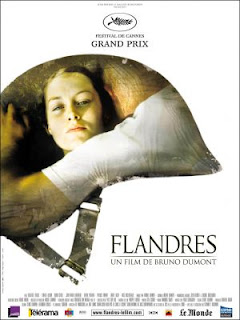
Flandres (2006)

I had the chance to see this in Cannes but passed on it after a guy in my line to see a different film that I can’t remember the names of said he saw it and thought it was nothing special and overhyped. I also hadn’t heard of Dumont before, so I passed, and it won the Grand Prix and I was kicking myself. That year, the judges were anti-war happy and fell for Wind That Shakes The Barley and gave it their top prize; it the blandest film I saw at the festival that year. I assumed that this was another film that was awarded for being European and ‘exposing the horrors of war’ and didn’t mind missing it too much. This is certainly a better war-themed film than Ken Loach’s bore, and is one of my favorite war films of all-time now (not that that’s a great accomplishment as I only like a few). It is modest enough to not approach The Thin Red Line‘s brilliance, but it is perfectly tight and effectively horrible. The film’s protagonist is Demester, but the star of the film is Adélaïde Leroux as Barbe. She is a beautiful and complex representation of what I imagine to be the ideal Dumont woman. More than any other slutty female in his oeuvre, every bad decision she made made me cringe and want to grab her and shake her for not being the nice, put-together girl that she should be. She is the main vertex of the love triangle between herself, Demester and Blondel. Demester is the kind of pathetic slob that defines most of the males in Dumont’s films, while Blondel, initially, appears to be the sort of ideal guy that a girl like Barbe should be interested in. The tension that is left in suspension when Demester and Blondel go off to war had me unusually engaged in both characters safety in the dangerous battleground that they unsuccessfully raid. The drama that was put on hold in Flandres from the love triangle would have made an interesting enough film, and so I found myself engaged in Demester and Blondel’s safety primarily for the sake of the excellent payoff once they both returned from the war, or, the more likely scenario, what would happen if one returned without the other. This film studies the complexity of pure masculine nature as seen by Dumont and juxtaposes it with the nature of war, and, as is shown in the ugly rape during battle, the treatment of man by man can be a disgusting thing. Dumont’s characters wander in a world approaching soullessness, and his combination of sex and combat in this film is a vile but potent representation of his core ideas.

DVD: The First 4 Films of Bruno Dumont Read More »

Rainbow Cinema: Coraline (Selick, 2009)

I liked how simple the story was, but I left the theatre empty-handed with this (unless I win the Dunks!). I thought that the animation was beautiful, it seemed to run at a different frame rate than the 24 frames of the film, and it made it look slightly choppy, which I thought was charming given the latest pristine animation of Pixar and Dreamworks. Not as instantly appealing to goths and hipsters as The Nightmare Before Christmas, Coraline had the same effect on me as Nightmare minus the catchy songs. The film takes a bit of time to get going, allowing me to experience life with Coraline and her parents before the creepiness is attempted. Coraline crawls through a rabbit hole in her house that flips her world into her ideal version of her reality, except that her parents and friends have buttons for eyes (I think many will say it is Alice in Wonderland meets David Lynch). I should note that my screening, for whatever reason, didn’t show the film in 3D, so I didn’t experience any scares that occur in the film because of objects or people flying off of the screen at the audience. I’d was looking forward to the film being in 3D, as it would have been my first feature film experience with that technology. I’m skeptical and critical of the practice despite never experiencing it, especially when it is applied to films made without 3D in mind. But I think I remember hearing that this film was designed for 3D. But, as I didn’t get to see the film in 3D, I cannot speak for the audience that did, and this film wasn’t scary or creepy or unsettling, and was kind of lame during its attempts.

I do applaud the naked old women on the trapeze, though. All of the kids at my screening gasped at what could have been the largest breasts proportioned to any woman that they had ever seen in their lives, commando save for the nipples. These two women were a couple of the better characters in the film, but their dogs were even better. The women collected scottish terriers that they stuffed and gave wings when they died. The dogs were dopey and drunk on something and very cute. I laughed.

But anyway, Coraline is pretty harmless and inoffensive, and it borrows too much from Alice in Wonderland, and has a muddled final act. Coraline wasn’t a very good protagonist, and none of the supporting characters really left a lasting impression on me. I support the stop-motion animation, though. It is nice to have variety in animated features so that children don’t become too reliant on the technology as a standard for their entertainment. If the characters and story were as developed as some of Pixar’s or early Disney films, it would have been great.

Rainbow Cinema: Coraline (Selick, 2009) Read More »

DVD: Fitzcarraldo (Herzog, 1982)

When I was in the 4th grade, I lost the spelling bee because I mispelled the word ‘epic.’ I spelled it E-P-I-K. Pretty pathetic for a nine year-old. When I told my best friend, he slapped me. I knew the word because there were blockbuster films that were advertised as being epic on the TV spots, but I didn’t have any recollection of actually reading the word. In terms of filmmaking, I think that there are ‘Epic” films, and I think that there are ‘Epik’ films. ‘Epik’ films are defined by their budgets and mainstream appeal, B-movies that feature internationally recognized celebs playing dress-up in front of green screens, films that don’t earn their excessive running times. These films are films that I avoid, and when I am tricked into seeing one (most recently, The Dark Knight) it makes me crave all-the-more a seventy-five minute art film about a man in a row boat, or two people having a dinner conversation. But, then there are the ‘Epic’ films, that restore my faith in ambitious filmmaking. Fitzcarraldo is one such film. While I was watching the visual climax of this film, a memory of a making-of documentary of Titanic that I saw around late 1997 crossed my mind. The crew of that film made a pretty exact replica of the Titanic, about 1/50 of its original size, and filmed it in a large pool of water to get a lot of their effects shots. Despite all of the precision and tedium and craft that went into making that replica for those scenes, it doesn’t even come close to producing something as magical, grand, and real as what Werner Herzog pulls off in this movie.

The premise of a man trying to build an opera in a village in the jungle is as out-there as one could expect from a Herzog film, and it utilizes one of his most prominent themes of a man who is passionate about something, and the peculiar detours that are encountered in his attempt to satisfy that passion. While Kinski plays the title character well, creating the kind of ferocious madman that was called for in this role, the real protagonist of the film is the opera genre. Fitzcarraldo’s love for the opera is what drives the film, and it is the main motivation for such stunts as dragging a massive ship over a mountain. Any arrogance or madness that is present in Fitzcarraldo’s character is born through the Carusos and Wagners of the world. These men’s works have possessed this man into a kind of operatic being that is probably not even capable of doing something in a manner that isn’t grandiose and dramatic.

As Herzog calls this film his ‘greatest documentary,’ it is worth bringing up Herzog’s similarities to the character Fitzcarraldo. Any ambition and madness that consumed Fitzcarraldo to drag the ship over the mountain is equally present in Herzog. Both are doing this huge task for the sake of bringing art to the masses, or perhaps the artless. I have no doubt that the arrogance of the title character is present in the filmmaker, too, but it is also outlined with modesty. Spoiler – – – The film ends with Fitzcarraldo failing somewhat in his venture to build an opera house in Iquito, but he still is able to scrap together a performance of Bellini’s I Puritani on the boat that he dragged over the mountain for the village to watch from the lakeshore. Fitzcarraldo, earlier shunned and scolded when he played Caruso over his record player, isn’t humble in his reception of the villagers’ awe, but I got the sense that he earned his moment of glory, as he managed, in his failure, to still pull off something new and epic for these people, even relative to the normal conditions of opera, just as Herzog did with this film.

DVD: Fitzcarraldo (Herzog, 1982) Read More »

DVD: Through the Olive Trees (Kiarostami, 1994)

This is the final film of Kiarostami’s Koker trilogy, which began with Where is the Friend’s House? and And Life Goes On…. The films in this trilogy got progressively more ‘arty’ as it went along, and self-referential. Friend’s House is a simple film about a boy’s journey to help his friend, then And Life shows a man who represents Kiarostami searching for a boy from Friend’s House, and now Through the Olive Trees features two men who represent Kiarostami. The trilogy peels away one layer of fiction to reveal something supposedly non-fiction, and then turns around and peels back again to completely fuzz what is and isn’t reality. Kiarostami seems to compulsively create fiction about non-fiction, and doesn’t know when to quit.

This film takes two seemingly insignificant characters from And Life and creates a new fiction underneath the fiction. The film is about non-fiction, and yet it is fictitious. I feel like I’m trying to write about a Charlie Kaufman film right now, but there are some very fresh things happening in this trilogy that go beyond Kaufman’s study of art’s imitation of life (and vice versa). First, Kiarostami is playing with the memory of his past films in a way that I am crazy about. With each film, the ideas become more and more enhanced by whether or not I was paying close enough attention to the previous film. I actually had no idea who Hossein and Tahereh were until about two-thirds of the way through this film it clicked and I felt silly for not making the connection before. These are sequels that actually embellish the previous films rather than rehash or thin out the themes of the predecessors.

But beyond the mirrors and reflections involved in the trilogy, each of the three films still focuses on its own ground. Through the Olive Trees, despite being based on characters from And Life, has its own goals and ideas that are separate. Hossein is madly in love with Tahereh, but his class and illiteracy keep him from having her. Tahereh is controlled by her grandmother, and is, consequently, bitchily unresponsive to simple comments and questions from Hossein. The culture and traditions specific to this region come between them and its frustrating to watch.

One trait of Kiarostami’s filmmaking that I’ve noticed is his characters’ repetitive and persistent nature. The children ask questions up to a dozen times before they get the answer they want or are finally convinced that they aren’t going to get their desired response. The filmmaker in this film (the actual one, not the fictitious one from And Life) goes through take after take as the stubborn actors change the script, often to make some sort of point. Tahereh will not call Hossein ‘Mr Hossein’ because the women in the region do not say ‘Mister’ and Hossein says that 25 family members died in the earthquake for three or four takes before he succumbs to the inaccurate total of 65 that the filmmaker is asking him to say.

Which brings up probably my favorite theme in this film: the actors’ resistance to fictionalizing their lives. The rules of the culture are constantly interrupting and altering the fiction that the filmmaker is trying to portray. In the final scene of the film, Hossein ceaselessly begs for Tahereh’s hand in marriage, but she will not budge on what she has been told. In the last moments, Hossein has either given up, or Tahereh has finally said yes. Hossein, chasing Tahereh in a zig zag up until now, breaks the motif of the trilogy and stumbles diagonally back toward the camera.

DVD: Through the Olive Trees (Kiarostami, 1994) Read More »

DVD: Crimson Gold (Panahi, 2003)

This is the first film that I have seen by Jafar Panahi. I wanted to watch Crimson Gold first because it was written by Abbas Kiarostami, and I wanted to see how his writing was treated when it was being directed by somebody else. I don’t think I would have picked up on Kiarostami’s participation in this without already knowing about it, as the only thing that I noticed that was particularly Kiarostami-esque was that the film was somewhat structured around traveling. Hussein, the protagonist and a pizza delivery man, rides on his motor bike from the pizza shop to deliver pizzas to various fancy homes, and can’t seem to have a smooth shift. The middle act of the film is centered around a mansion that is having a dance party of some sort. Outside, though, some form of police is waiting to pick out the people entering and leaving the party, as it breaks some sort of code that restricts men and women from dancing with one another. When Hussein arrives to deliver a pizza at the mansion, he is pulled into the situation and not allowed to leave or deliver the pizzas. Later, he is delivering pizza to a lavish condo, and the man living there, who ordered pizza for himself and two women who left before the delivery, invites Hussein into his home to eat and chat with him. While the rich man blathers on and on about his disdain for the city and his general joylessness, Hussein inhales the pizzas. The antagonism of members of different classes provides the infrastructure for this film, and renders well the quiet hopelessness and hostility that builds up in this particular member of the working class.

The film has an interesting formal structure that shows Hussein’s fate in the first shot of the film, and then spends the rest of the film showing the events that built up to that moment. While the film does show a convincing portrait of a nice and innocent man being driven to crime by society, it doesn’t make excuses for Hussein’s final behavior, and doesn’t make the final scene in the jewelry store out to be some kind of inescapable fate. The logic of the events is very loose and subtle. Hussein’s time wandering through the rich man’s condo, the penultimate scene of the film, is complex because it isn’t clear whether Hussein is angered by what he sees and hears or if he is entertained by it. He falls into the swimming pool, and I couldn’t tell if it was his awkward way of diving in, or if he fainted. He stares out at the city pensively, and burps up his pizza, and I didn’t know whether to find this moment humorous or somewhat disturbing.

Hussein is acted well by Hossain Emadeddin, playing him as someone who isn’t insane and still functions in the world without being perceived as an outcast, but who can also believably go off the rails at any moment. I am unsure about the decision to show Hussein’s fate at the beginning of the film, as I think I was less engaged in his behavior than I should have been. Since I know what he will end up doing, I looked for certain things in his personality that I wouldn’t have otherwise, and probably missed out on much of the complexity that was put into Hussein’s character. It is an effective film, though, and I enjoyed watching it.

DVD: Crimson Gold (Panahi, 2003) Read More »

DVD: Bug (Friedkin, 2006)

Never a fan of The Exorcist, nor Lionsgate’s trailer for this, I watched Bug with reservations. I’d been hearing all kinds of praise for Michael Shannon around the internet, but I’d never seen him star in a film before this one, though he played a weak role well in Revolutionary Road. The truth is that as great as Shannon is in this, Ashley Judd is even better, and the two of them lead an all-around extremely well acted cast. I didn’t know that this was an off-Broadway play until after I was finished watching it, but I couldn’t stop thinking about how much this felt like a play while I was watching it, as pretty much all of the film consists of dialogue between Judd and Shannon in a motel. The first half of this plays like an engaging, yet standard, study on relationship abuse. Judd’s Agnes is haunted by her guilt of losing her son, who was kidnapped at a grocery story under her supervision about a decade before the film takes place. Her ex, Jerry, has just been released from prison, and is anxious to get back in Agnes’ life to terrorize her simply because he is an asshole. The real meat of the film, though, is brought in after Agnes and Shannon’s Peter hook up one night. Soon after they sleep together, edited cleverly with archival footage of mating insects, Peter begins forming bite marks from tiny aphids that he finds in the motel. Agnes begins to be bitten by the bugs, too, and the two begin searching for the aphids obsessively, and researching not only how to get rid of them, but how they got into their room in the first place.

This film is one of the scariest and most tragic examinations of trust, abuse, and madness that I have seen. I was reading a few articles in the news after I watched this, and, still under a daze from the movie, I couldn’t tell if what I was reading was believable or a hoax. I’m finding it hard to write about this even now, because it affected me so viscerally. The final act was like an extension of the hungry refrigerator scene from Requiem for a Dream. The blues and the buzzing and the spastic characters were incredibly unnerving for me. The film is also very funny since it’s so over-the-top at times. But anyway, I can’t stop thinking about this, even though I can’t seem to put any of my thoughts on it into words. Its unfortunate that the horrible marketing kept me away from it so long.

DVD: Bug (Friedkin, 2006) Read More »

Cinematheque: Mommy Is at the Hairdresser’s (Pool, 2008)

I had the chance to see this at the Toronto Film Festival, but ended up passing on it because it fit awkwardly into my schedule. The synopsis grabbed my attention, and then it started getting some pretty good reviews, so I regretted missing it. Fortunately, it was picked as one of Canada’s Top Ten, which are playing right now at the Cinematheque Ontario, and I was able to see it there. It took me until the second act to get into the rhythm of the film, but once it laid back on the cliches and the mother (played weakly by Céline Bonnier) left the picture, I was more interested in what was going on, and it even ended up being pretty moving throughout its final act.

Mommy is composed of bright colors and infused with a general hokeyness that is reminiscent of an early Coca Cola commercial, and reminded me quite a bit of Haynes’ Far From Heaven (the look and the subject matter). The superficial perfection and underlying sense of something being wrong seems influenced by Blue Velvet, especially after a bird goes kamikaze on the kitchen window, and when some neighborhood teens gather in a closet to spy on one of their mothers undressing. The film feels like it could go in a couple of uninteresting directions in its first half hour (like focusing on the closeted father or the creepy deaf man) but deviated from them so much that I think that they were just MacGuffins. The real meat of the film is in the mother’s absence, and how that affects the family. Feminists will be pleased to know that the family pretty much disintegrates. The disintegration is handled well, and subtly enough. The star of the film is easily Marianne Fortier as 15 year old Élise, a Bressonian character that seems to absorb the downfall of the family singlehandedly. This film made me long for childhood more than Davies’ The Long Day Closes, even if it isn’t as obviously made by an auteur.

I was impressed by how unpretentious this film ended up being, which is probably why I was able to forgive it of its mistakes. There isn’t really anything flashy going on with the camera, editing, or music, so I was able to take it in more based on the story and the acting than the film as a piece of art. The film closes on a scene that should have been cheesy (it was a little, and had a few people in my audience burst into laughter) but felt honest. Élise races through a field with her youngest brother while the song ‘The Great Escape’ by Elie Dupuis plays over everything, creating an excessively sentimental finale that works. The cut to black after the hopeless idea suggested by Élise was a perfect and moving ending.

Cinematheque: Mommy Is at the Hairdresser’s (Pool, 2008) Read More »

Cinematheque: The Long Day Closes (Davies, 1992)

After I was underwhelmed and unaffected by Terrence Davies’ assured debut feature Distant Voices, Still Lives earlier in the week, I was looking forward to this follow-up and thematic sequel. I’d heard that this was a maturation of Distant Voices and I anticipated connecting with this more since it was focusing on one subject, and since that subject was representing Davies himself. Having seen it now, I agree that it shows Davies maturing and developing his style and storytelling further, but I was even less emotionally engaged in it than I was with his debut. I was even annoyed with myself and the film that I cared so little for the characters, because everything in this film is so well done that I don’t see how I could have had such an empty response to it, especially while everyone around me in the theatre was sniffling and wiping their cheeks.

The films opens similarly to Distant Voices, with the camera roaming the street and then wandering into the doorway in which the boy and his family live (which I think is the same house that the family lived in in Distant Voices; the entry and stairs look the same, anyway). From here, The Long Day Closes evolves in a similar manner as Distant Voices does. The film is mostly made up of small scenes to get prescription drugs without a prescription that sort of work on their own, but aren’t designed to progress from one to another. We see Bud, the protagonist, pensively stare out the window at shirtless workers, get bullied at school, bashfully strip to go swimming, and interact with his family. Davies limited the sing-alongs a bit more here, but there are still more than I would have liked. While I was trying to find something in the film to grab ahold of and care about, I was instead given singing. Unlike in a musical, though, the singing and lyrics don’t progress the plot, nor do they introduce ideas or develop the characters; they just took up time that I’d rather have had with Bud and his mother and brothers. Which I think is the main issue I have with Davies’ films, is that I think he is more interested in these romantic depictions of memories, portraying them beautifully, set to wonderful music than letting the viewer know what these memories mean to him. I honestly cannot tell if he is showing memories that he is fond of, memories he wishes he could forget, both, neither, or something else. For all I could tell, he was picking memories that would look the best in the film, like the closing shot of the sunset (pictured in the poster above). While gorgeous to look at, I wasn’t nearly as entranced by it as I was by a similar shot at the end of Silent Light. But it had every right to be just as good as, and better than, that shot. But like the rest of the film, it just happened, and meant nothing to me.

Cinematheque: The Long Day Closes (Davies, 1992) Read More »