Author name: Blake Williams

DVD: Glue (Dos Santos, 2006)

The cumulative effect of this movie very much exceeded my expectations after the first 15 minutes. I was pretty worried during the film’s opening that I was in for 100 minutes of teenage angst, artfully filtered and tritely narrated. Fortunately, Alexis Dos Santos appears to be a gifted director, and he creates some very real and sympathetic subjects with character types that are difficult to portray in any kind of fresh way: the ambiguously gay virgin, his seemingly white-trash mother, the dorky girl friend, the absent neglectful father, the straight(er) guy friend, snotty sibling, etc. I didn’t have much of a reason to be optimistic during Lucas’ prologue, where he asks deep questions like “If my parents made love a month before I was conceived, would it be me being born? or another boy?” and “do girls like sucking dick?” He wants to get laid so that he will “stop waking up all sticky.” I thought I was watching a Larry Clark film for a moment, or maybe a Gummo outtake. I’m not sure if Dos Santos actually just made a good film with a weak opening, or if he intentionally structured this like a typical coming-of-age bore in order to make the rest seem so transcendent of the genre. Or, he is critiquing the genre.

Well, perhaps the film didn’t immediately get better after the opening. I didn’t actually appreciate any of the characters until about halfway through. I initially thought the film was focusing on Lucas’ repressed homosexuality, and that Dos Santos was using his friends Nacho and Andrea as the vehicles to express the realization. But, like Lucas’ delusions of successful songwriting and rock-n-rolling, and his parents’ delusions of being able to fix a crumbling family, Lucas just seems like he’s doing what he’s suppose to do, wondering things that he’s supposed to wonder at his age. His experimentation with Nacho is less an example of homosexuality than an exploration that every straight man wants, but represses. Lucas is so likable because he is ballsy and goes after what he wants. I like Dos Santos, too, for ballsiness. Argentinean cinema is getting progressively more exciting with every new filmmaker that I am acquainted with from the country. Considering their Malbec wine, Argentina is beginning to rival Thailand as my number one fantasy destination to have a ‘dinner and a movie’ date.

DVD: Glue (Dos Santos, 2006) Read More »

DVD: Céline and Julie Go Boating (Rivette, 1974)

When I started this project of immediately writing my first reactions to every film that I watch, it was purely for personal use. I wanted to have some kind of a log for the films I was seeing, and I wanted to log these films in a less lazy way than making a list of titles. I love making lists. I have several lists that I’m building right now, including a monster ‘decade’ post that I hope will be ready by Dec. 31. While I keep all of these posts in a text document on my hard drive, it also makes sense to me to post them online on this blog so that I can access my thoughts from anywhere, even if I’m not at my computer; also so that some of my friends can read what I think about the films I am seeing, what I recommend, etc. I’m not a film journalist, and I typically avoid being too analytical about films I see. I’m not very good at deciphering what a filmmaker was going for with each film, nor how successful a film is in the context of film history; I often zone out for large chunks of a film, thus I think it’s pretty common for me to dislike films that are actually quite good. The only research I tend to do between watching a film and collecting my thoughts on this blog involves looking at particular names of cast members on imdb or wikipedia, and reading a few reviews of the films from NY Times, Slant, and Armond. Reading these helps me to remember certain things that I was thinking during the film, so that I can make these entries as thorough as possible. As I said, I write these for personal use, but I’ve noticed that a handful of people that I do not know are reading; the internet can bring some unexpected surprises. So I’ve started putting more ‘effort’ into these things. I panic when I notice I’ve published something with grammar and spelling mistakes, and I’m wary of the pedestrian observations that a rough reading of a film can be composed of.

Anyway, this is the 100th review that I’ve posted on this blog, so I thought I’d offer a belated Mission Statement of sorts to preface my actual thoughts on Céline and Julie Go Boating, Rivette’s ridiculous masterpiece of a film. I had a ticket to see this at the Cinematheque Ontario last December, in a 35mm print, but I missed it because I made plans to visit some friends in Boston. I knew that this was considered one of the great neglected films of the DVD world, so it killed me to miss it. I picked up the BFI disc, a nice set but it has a generally fuzzy image quality. I’m no aficionado of the French New Wave, and this was the first Rivette film that I have seen (I have Va Savoir and Don’t Touch the Axe now, though, and I hope to watch a bootleg of the 13-hour Out 1 by the end of the summer).

The main film that I was thinking of while watching this was INLAND EMPIRE. It’s hard to deny the similarities: women mirroring women, women watching themselves diving into unknown worlds of melodramatic, dangerous fiction as if they are watching a film, the three+ hour length, etc. A big difference, though, is that this film’s transformation came out of nowhere. In Lynch’s film, one can sense from the brooding and bizarre opening 5 minutes that the film will not succumb to any sort of logic. The surprising thing is that it takes almost an entire hour before Laura Dern chases the rabbit into its hole and sends the plot into oblivion. Rivette takes care of that chase right at the outset of Céline and Julie. Julie follows Céline the moment she sees her pass in a park, dropping her belongings along her way. Much like the pursuit at the heart of In the City of Sylvia, an actual confrontation seems to be avoided for the simple fact that it would end the enthralling chase. While Julie initially calls out to get Céline’s attention, she quickly shifts from being a good samaritan into an unsubtle stalker. But, as is the case for much of Céline and Julie’s relationship, their roles flip flop, and Céline is soon stalking Julie in the library.

The film continues, looking at the girls’ co-interests in magic and taunting men, introducing the possibilty of a lesbian affair between the two, while the real meat of the film is only lurking in its second half. What I thought was going to be a fun, simple film about the relationship between these girls turned into a complex and exhausting meta-movie. The film complicates itself repeatedly, but it is refreshing, because Rivette is clearly having such a good time with it. While Lynch shows the filmmaking process as an ominous mystery, like playing a score of Penderecki as characters burn holes in silk fabric with cigarettes to look through to the ‘fictional’ version of their lives, Rivette has his characters suck on colorful candy that looks like Jolly Ranchers, cutting back and forth between a tacky soap opera/whodunnit and shots of Céline and Julie sitting attentively, laughing hysterically at what they are seeing.

The pacing of the film is all over the place, just as the film bounces around from one genre to the next. The repetition of the middle third of the film does become hazy, but I was never bored or irritated. The last thirty minutes of the film, though, in which Céline and Julie manage to enter the mansion together, is an explosion of pure entertainment. It is the definition of a climax in a film, putting everything from the film’s first two and a half hours to use. Watching the girls interact, physically and fully aware, with the world that they have been itching to play with throughout the entire film, is exhilarating and hilarious. The mirror scene, in particular, was its own mini masterpiece, a perfect summary of their relationship. But it isn’t all just fun a games; there are some genuinely unsettling things happening in this mansion. The decor, lighting, and camera placement reminded me of the iciness of The Shining, and the characters of the melodrama feel like ghosts who are stuck in a Groundhog Day-like limbo in which they must recreate the same story every day for eternity. Are there people in my DVDs, reenacting the movies over and over again, waiting for me to come in and join/rescue them? This film makes me wonder…

DVD: Céline and Julie Go Boating (Rivette, 1974) Read More »

Cinematheque: Snow (Begic, 2008)

This film is part of a ‘Human Rights Watch’ festival that is currently taking place at the Cinematheque Ontario. The film follows a cluster of Bosnian women and girls who try to continue making a living after the men in their lives have been taken by war. The women, who already have a shaky footing in life, are disturbed by two men who show up trying to get their signatures in order to acquire their land. As their success in this endeavor becomes evident, tensions build in the women and in the plot. My main problem with the film is that the women had very little redeeming value; I think that the absence of men had somehow put all of them on permanent PMS overdrive, and I couldn’t stand any of them. While this is probably the point, it made for an irritating two hours. While a similar plot synopsis can be drawn from Women on the Verge of a Nervous Breakdown, the difference is that Almodóvar sees the humor of the situation and lacks pretension. The film only manages to become a bit more interesting by including a few elements of magical realism.

I’ve noticed recently that magic and spiritual realism have been making a huge comeback in the art and film communities so far this century. On a recent trip to New York, almost every gallery and museum that I went into had some sort of exhibition up that showed work by artists who are studying miracles, ghosts, Zen meditation and hypnosis, religious parades, divine lights, etc. Films by Apichatpong Weerasethakul and Semih Kaplanolgu take notice of ethereal and folkish occurrences in the quaint lives of their protagonists, and acknowledge the religious experience of witnessing an ominous light or vacuum, some natural, some man made. My main annoyance with Snow, is that it has the pieces to have been an important human rights or magical realism entry, but is significant to either because it handles these elements absurdly and makes it all look silly. A boy who goes through a brief stint of aging rapidly when he has a traumatic experience made me laugh and then cringe, as the boy is suddenly shown with much longer hair (I think pretty obviously a wig) at one point. Several people in my theatre giggled, but at least I finally understood why Begic felt the need to insert abrupt chapter breaks that told me what day it was, as it initially seemed as if either a large chunk of time had unexpectedly passed, or the boy was playing a silly game on everyone. Not to mention the snow in the last scene of 1997, a Magnolia or Haggis-Crash-esque divine sign of exhaustion and fateful intervention.

Cinematheque: Snow (Begic, 2008) Read More »

DVD: Gerry (Van Sant, 2002)

Certainly my least favorite of the Death trilogy, I think that viewing the trilogy out of order diminished the potency of Gerry for me. Had I seen Gerry when it was first released in the cinema as a follow up to Finding Forrester, I think that the sparseness and ambition of it would have been more jarring. I mean, it’s unsettling enough seeing a film with Matt Damon and Casey Affleck; who knew Damon would be willing to make a film with the other Affleck? As each film in the trilogy is based on a story that Van Sant read in the newspaper (two hikers getting lost in the desert, school shootings, Cobain’s death) I think that the shuffled Bostonian pairing must be at least somewhat significant to Van Sant’s pop culture obsessions. Van Sant credits Bela Tarr in the closing credits, who seems to be one of the main influences for this new style that Van Sant pulled out of the air. Though I think that the borrowed tracking shots and tone are welcome and fitting for these films, Gerry ever reaches the realistic mysticism of Tarr’s work (which I think he does reach in Elephant and Last Days). While moments of this film are hypnotic and beautiful, the meandering becomes, not boring like so many people complain, but tired. Some reviews I’ve read suggest this ‘would make a great short’ but I think that much of the endless wandering is essential. Perhaps shortening it to, a still feature length, 55 or 60 minutes would fit it well. I normally frown on suggestions for abbreviating films where ‘nothing happens,’ but I don’t get anything about of the 55min.-85min. segment of the film that I didn’t get in the first 45 minutes.

That said, there are a lot of interesting things happening in the film. The name/term gerry is used to describe turns and detours, and is also both characters nicknames (I thought it was their God-given names, but Van Sant has said that their names are never said, and they only call each other Gerry). This is one of a few suggestions that Affleck and Damon’s characters are each half of the same character, Damon’s. One is more logical in his attempts to navigate the desert while the other is more instinctual. There isn’t much dialogue in the film, so there are only a few arguments for or against this theory. The death/murder/mercy killing at the end becomes much more interesting if it is in fact one person instead of two, while as a more straight forward narrative it is sad but predictable. The death scene is also notable as it is the most subtle example of spontaneous homoeroticism of any of the films in the trilogy; it was strange to see what I expected to be an imminent lovemaking scene turn into a murder. Finding the road at the end was unsatisfying for me, in the same way that the last scene of The Mist kills the tragedy of the film, despite it being an attempt at making the situation more devastating.

DVD: Gerry (Van Sant, 2002) Read More »

Film Forum: Katyn (Wadja, 2007)

This is my first Wadja film, who I might be ashamed to say I never even heard of until the Criterion Collection announced their upcoming Danton DVD. Seeing Katyn, I was initially somewhat surprised at how standard the film was. It is very similar in tone and appearance to Spielberg’s Saving Private Ryan. It does do a few interesting things though. The film follows several different stories, all of them stemming from the Polish prisoner-of-war Andrej. The cinematography is desaturated and browned slightly for an older, gritty look that makes the periodic leaps into archival film stock of the events at Katyn Forest feel like less of a separation in time. The acting is competent throughout, but I don’t think that anything necessarily stands out exceptionally. The film is difficult to write about because it is absolutely a ‘good’ film, but it doesn’t really good anything really interesting or really wrong. It’s a well-made historical document about an event that I was unaware of, and it compellingly brought it to my attention.

As a film by a supposed ‘auteur’ I was underwhelmed because of how objective and textbook it seemed to be. The most interesting thing about the film is its inclusion of very Catholic sensibilities, most notably the film’s final line being the Lord’s Prayer by a succession of men being offed one after another, closing on a shot of a fist-clenched rosary. It was strange and refreshing to see a film set in Europe in the 1940s, about an event in which thousands of innocents were killed, and for the religious bent to be Christian. The film doesn’t feel religious, though; it is definitely about the killing and repressed standards of living in wartime.

Other interesting moments involve small stories such as the young guy who ripped down a Stalin poster and was subsequently chased by Soviet soldiers until he had to run into oncoming traffic and was killed by a car. The Soviets were not certain to kill or even detain this boy, but I still viewed the circumstance as a murder. The ultimate force, then, was their threats, and not necessarily their actions.

I’m certainly gald that I saw Katyn, but it doesn’t make me want to seek out more Wadja. The slaughter of Katyn Forest is devastating and important for everyone to know about, but this film does aim to progress the genre.

Film Forum: Katyn (Wadja, 2007) Read More »

IFC Center: Crash (David Cronenberg)

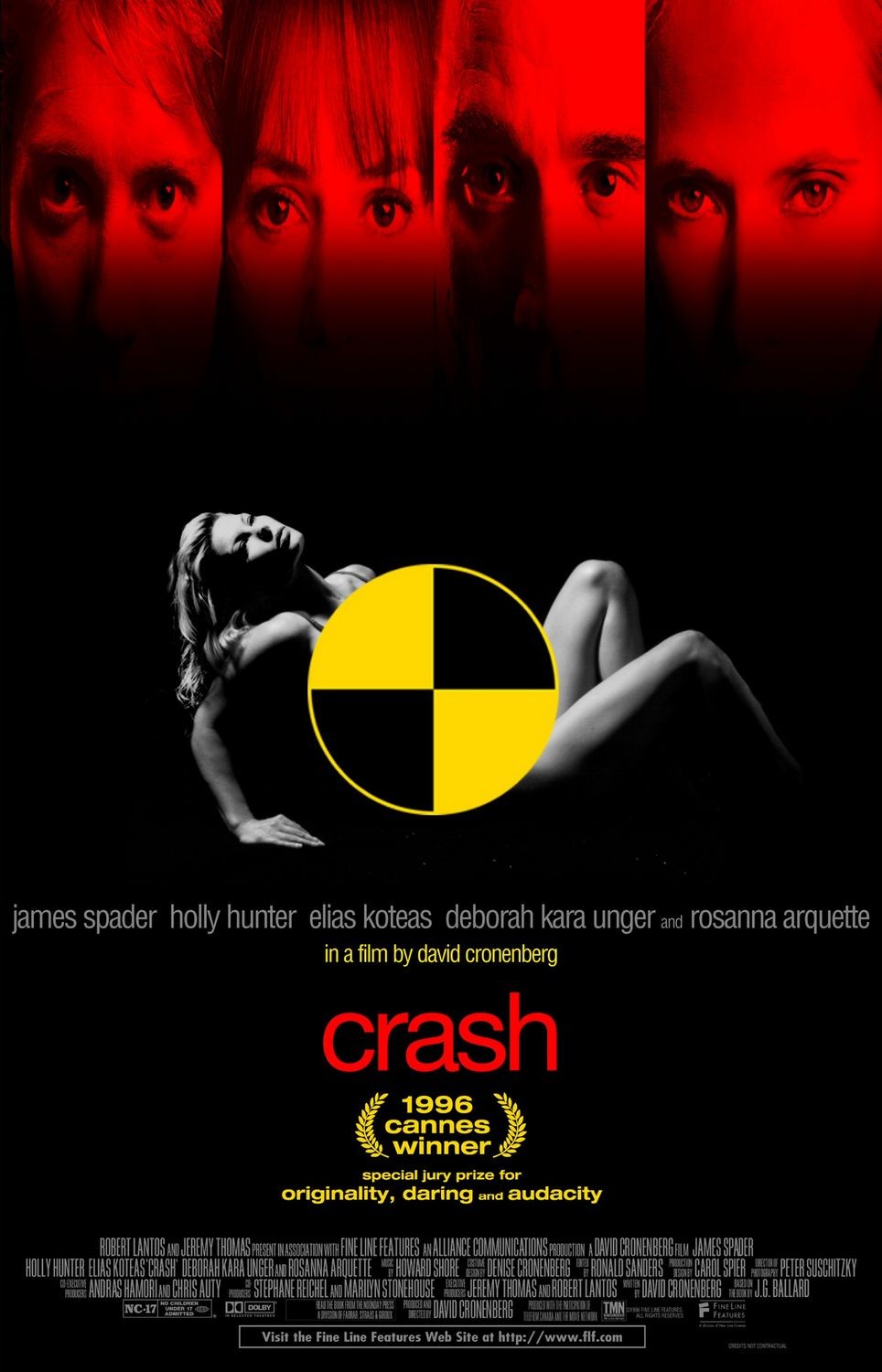
Long live the new flesh, indeed. I was fascinated with this Crash, the only Crash that should exist, but I still felt like it was a bit too much of a rearrangement and sexed-up version of the same films that Cronenberg had been making up until this point. It is more polished than anything up to this point, though, and is probably the best stand-alone film other than The Fly that I have seen by him. I often hear an opinion from people who confuse David Cronenberg with David Lynch because they are both weird, North American Davids working with a lot of violence and a lot of sex. But, I think that they have both been mislabeled for the sex in their films, which I don’t think there is even that much of at all. Lynch is on most people’s radars for the lesbian scene in Mulholland Dr.; the only time I’ve seen that film on the big screen was at the Coolidge Corner Theatre as part of their ‘Films that turn us on’ series. And I think that Cronenberg has similarly been branded for excessive sexuality in his films because of Crash, though his other films only have brief moments. Crash also has a lot in common with Wild at Heart, especially in these films’ presentations of sex.

Also similar to Lynch, and even more than him, Cronenberg’s characters have a stilted, 90s way of delivering their lines that was initially offputting for me been I first saw History of Violence. It’s easy to dismiss it as bad acting, but I think that these films very much come from and are influenced by common made-for-television movies-of-the-week and soft porn styles and conventions, and they seek to descontruct and demolish what those films stand for. While Lynch dissects and obliterates American ideals and fantasies, Cronenberg uses Crash to expose naive perceptions created by ‘movie sex’. The first few sex scenes, the first one at the plane, Spader’s early sex scenes, especially the ones in cars, all play like Red Shoe Diaries episodes. Tacky dramatic lighting, slow-mo thrusting, breezy music. The movie slowly but surely evolves away from that into a disturbing sado-masochistic fetish for car crashes. Characters reveal bizarre intentions and turn-ons that seems all the more crazy because of how the film was set up. The film asks the viewer to be open-minded toward such fetishes and non-vanilla sex, but it is difficulty to see the appeal of dismemberment, scars, and disability. The film successfully stretched my liberalism toward sex until it couldn’t be stretched anymore.

The characters in this film, like so many of Cronenberg’s films, can only be truly happy when they can remove themselves from their humanity, always working and building toward a more digital or mechanical way of being. Thus, it is consistent and important to Cronenberg body of work. However, I think that with this film he started showing signs of exhausting the idea, and he has since, thankfully, been moving into different but relative territory.

IFC Center: Crash (David Cronenberg) Read More »

DVD: Last Days (Van Sant, 2005)

Though I still haven’t seen Gerry, I think it is safe to say that this is going to be my favorite film in Van Sant’s Death trilogy, and is also my favorite of any of his films. There are a few things that I rely on appreciating when I go into a 21st century Van Sant film: long tracking shots, minimalism, and out-of-nowhere homoeroticism. All of these get big check marks in Last Days. The film got a lot of hoopla for being related to/about/referencing Kurt Cobain and his death. I don’t care or know anything about Nirvana of Cobain’s life; I don’t think I can name three of their songs. So I went into this trying to ignore that aspect of it, despite having to acknowledge its Warhol-esque pop culture cynicism. Formally, the film seems perfectly designed to put off Cobain enthusiasts who rushed into the film for a biopic on their fallen hero, which is the most likely reason this film has such an outspoken and inapporpriately negative reputation. The film really isn’t changed at all by Cobain’s name or legacy; this is a film about a distraught musician on his last leg. Fame doesn’t come into play at all, though I’m sure many people who see that as being a factor in Cobain’s suicide force that into their readings of the film; the film doesn’t attempt to answer any questions about why the protagonist is so depressed, because it has better things on its mind.

Despite standing on its own in a fictional universe, the film, like Elephant, gains a great deal of tension by the audience knowing that scenes of death are coming. Unlike in Elephant, Last Days leaves those expectations unsatisfied. The climax isn’t an intense killing spree or moment of reflection. When Blake (Michael Pitt) is found dead at the end, I was surprised at how unmomentous it is. It felt to me as if about five minutes of the film were missing that lead to the death. I wasn’t even sure that the body was Blake’s until his ghost crawls out of him and climbs up the windows panes, presumably into heaven. This scene is beautiful and strangely avant garde, flattening the space of the environment to allow for Blake’s ghost to grab areas of the frame that are out of reach in reality. Its a brilliant way to show the new reality that death would bring if there were an afterlife; time and space cease to exist in any comprehensible form. Thus, this gives the film a significant sense of spirituality that is either absent or only hinted at in the more realist Elephant. Not that Elephant is missing spirituality, it doesn’t call for anything of the sort. But it is a huge reason why I prefer Last Days. It’s a satisfying and baffling payoff to the meandering meditation that makes up the rest of the film, and is the most optimistic of any of Van Sant’s finales that I’ve seen.

DVD: Last Days (Van Sant, 2005) Read More »

DVD: La Cienaga (Martel, 2001)

Updated @ 3:40PM on 2/15/09

Martel’s debut only got better with my second viewing of it. It is one of the most brilliantly disorienting films that I have ever seen, with every scene having something uncomfortable on display. But it is done subtly, and I only really notice the effect that the film had on me once it ends. But my reaction is immediate. It’s like I’ve been put under a spell, and when the credits fade in I snap out of it and everything that the film has done to me instantly takes its toll. Having now seen The Headless Woman (though only once) I still much prefer this one, but it is nice to know that she is still working toward similar goals: controlling and frustrating the audience at will, presenting circumstances that are almost mundane but are just off enough to hesitate and disrupt the film’s flow into and out off my consciousness, dazing me just as her characters are dazed.


I’ve developed a strange infatuation with the idea of Lucrecia Martel over the last three months. Before La Cienaga, I had not seen any of Martel’s three features. I had a vague interest in seeing her new film, The Headless Woman, when I was at the Cannes film festival last May, but a swift word-of-mouth of how awful it was turned me off and I decided to skip it. Fast forward a few months, and I get an issue of Film Comment that shows near unanimous praise for the film among the magazine’s 8-10 critics, many awarding it a 5 out of 5 stars. Then I read that Apichatpong Weerasethakul, who was on the jury at Cannes, considered it the best film in the Competition. Add to all of this the unfulfilled expectation of its inclusion in the Toronto Film Festival, and the missed opportunities and hidden proclamations of masterpiece status were enough for the film to explode in my head as some sort of misunderstood masterpiece, the best kind.

So I went out and bought Martel’s first two features, and put off watching either of them for one reason or another, and now I’ve finally gotten a chance to watch this one, her first film. If The Headless Woman is anything near the quality of La Cienaga, then Martel will be one of my favorite living filmmakers, because this film is spectacular. It somehow manages to tell an epic story about a woman who drunkenly falls and cuts up her chest on broken glass, and the family and friends who swarm around her as she recovers. Her life is never in danger, so in that way it is different than recent Desplechin films, but it has a similar vibe to his Kings and Queen and Un Conte de Noel.

There are all kinds of sexual tensions running through this film, and children carelessly shooting guns in a forest, always just about to shoot each others’ heads off, and a religious phenomenon that has the media in a frenzy. My head was spinning the entire time. Sometimes I had no idea what was going on, and I’m still unsure of many of the characters’ relations to one another. But the cumulative effect of the film is dazzling, hypnotic, paranoid, and somehow perfect.


DVD: La Cienaga (Martel, 2001) Read More »

DVD: Old Joy (Reichardt, 2006)

I didn’t know that Kelly Reichardt had made a film previous to this one until a few minutes ago, so I’m having to tamper a lot of my gushing over it for being such a strong debut as I’m writing this. Reichardt certainly seems to be a director ‘of the times;’ she shows very strong sentiments toward the environment (city versus ‘the outdoors’) and economy in her films, especially showing the tension between the lower and middle classes. In Old Joy, Mark is representative of a ‘comfortable enough’ mindset, as he and his wife are about to have a child, seemingly because that’s what people do, even though they do not seem to have the time or funds to appropriately raise a kid. Kurt, clearly of a lower class (I’m still not sure whether he is homeless or not), sees through the veils of society in a very hippy/hipster way, fittingly ‘one’ with nature. He lures Mark away from the domain where he aims to address and identify what exactly it is that has come between the two of them as friends. The film’s themes of growing apart and the awkwardness of visiting the past are universally presented and are successfully applicable to any viewer’s sense of change, but I think Reichardt’s central examination is of the tensions that exist between classes, and she uses two best friends as the the vehicle for her exploration of this idea. Mark and Kurt have probably been friends since high school, if not before that, and were presumably of the same social class at one point. But Mark’s conservative tendencies and Kurt’s hipsterism drove their lifestyles apart, and thus it now seems impossible for the two to continue any sort of genuine friendship. Kurt does break his silence at the campfire on the first night of their trip, but he quickly retracts his concern and hides it away again; the film is so effective because of the constant tension between Mark and Kurt that remains stubbornly hidden. Thus, everything between them feels false or artificial in some way, and I felt like when Kurt gets out of Mark’s car at the end of their trip and then waves goodbye with a hammy smile that they would probably never hang out with each other again.

The sauna scene at the end of their trip is so relaxing to watch. The sounds and greens combine for a kind of ‘Pure Moods’ effect. Then Kurt gives Mark a massage and I just about fell asleep it was so calming. I’m prone to falling asleep during massage scenes in films, so I saw it coming and sat up and rubbed my eyes to keep myself from succumbing to the looming unconsciousness. This film has a very special and simple idea and presentation, and I’m glad that Wendy and Lucy proved that it wasn’t a fluke. Reichardt is one of my favorite American filmmakers right now, and I am looking forward to her upcoming period piece (?).

DVD: Old Joy (Reichardt, 2006) Read More »

Blu-Ray: Chungking Express (Wong, 1994)

My faith in Wong Kar Wai is being restored as I catch up with his earlier films that I never got around to watching. I loved Happy Together, and now I very much liked Chungking Express. My problem with his more recent films is that it seems like he’s too consciously creating these romanticized scenarios and throwing out substance from the films. I’d written him off after seeing his overpraised 21st century work because I thought they were nothing but style, and a style that I didn’t even like very much. I also didn’t like his use of music; he reminded me of Tarantino, gone soft. Though Chungking Express might have tired out ‘California Dreamin” for me for the next couple of years, his use of pop music in this and Happy Together feels more inspired and creative, and also less awkwardly and self-conscously ‘in’ (Cat Power and Norah Jones?), than his newer work. While my memory of In the Mood For Love is hazy, the two things that stick out in my mind are slow motion glances and that theme song that must have played twenty times in the film. My disappointment in that film still hasn’t completely worn off.

But other than the music, Chungking is more formally interesting than anything else I’ve seen by Wong so far. Not knowing anything about the film going into it, I was surprised by the abrupt shift into an apparently separate film altogether, dividing the film into two lovesick cop stories. The noirishness of the former half cuts into a more sunshiny telling of longing, brought in by Faye’s naive airiness and the nearly incessantly playing Mamas and the Papas track. Tony Leung’s Cop 663 is less dopey than Takeshi Kaneshiro’s Cop 223 from the first half of the film, but is still able to have a sense of humor about his romantic misfortunes. When he talks to all of the inanimate objects in his apartment as if they are having the same emotional reactions and feelings that he is experiencing, it’s funny and sweet without making him seem pathetic. Cop 223 is funny but also kind of obnoxious; it makes sense that he has trouble finding a girl that will stay with him.

I had the feeling that I was missing a few things while watching this that will make me like the film even more the next time I see it if I can pick up on them. I thought that the wrap-up at the end was either, or a combination of, rushed, muddled, or contrived. It felt weak considering how well placed everything before it had been. But still, there is a coldness that I get from all of Wong’s films, even the ones I like, that I think will prevent him from ever being one of my favorite filmmakers, but I’m still more than happy to occasionally dive into one of his films.

Blu-Ray: Chungking Express (Wong, 1994) Read More »