Bootleg: Picture of Light (Mettler, 1994)

One would hope that a film about searching for northern lights in the far corners of Canada would look better and have better food for thought than this documentary by Peter Mettler; but then again, maybe it’s just that no medium can do justice to this most elusive and ethereal natural phenomenon. The film captures the magnetic light show in hazy time-lapsed film, which the filmmaker attained by exposing 1 frame every twenty seconds (so 1 second of motion takes 8 minutes to capture). The product is pretty much akin to every other video or film you’ve probably seen of an aurora borealis. Worse than the footage, though, is that Mettler frequently goes off on various psychological and meteorological tangents that cause the film to drag, and can grate on the nerves. He tells the viewer, in voiceover, facts that are neither profound or new, like the Inuits have close to 170 words for snow and ice, as if we are supposed to be in awe of the information all over again. The narrator (who I believe is Mettler but was left uncredited in the closing credits) sounds like Kevin Spacey’s Lester from American Beauty; not only his voice, but his tone, too, with a relaxed, borderline cynical acceptance of the beauty of our world’s hidden treasures and mysteries. I’d all but given up on the film by the time he recites this gem while presenting footage of a pile of snow: “the first thing ever filmed was a train pulling into a station; the audience ran in terror. Cold yet?”

While it is obvious that the northern lights are only visible near the pole, thus making the experience of looking at them in person pretty damn frigid, the film spends far too much of its time concentrating on the well-below 0 temperature. In addition to the aforementioned 170 words tidbit which included a recitation of many of the words and their definitions), we are also treated to a fun, but again extraneous, experiment of how to create a snow drift in your hotel room (drill a small hole in the door before a snow storm, wake up next to a mountain of snow). Not to mention many many shots of snow, most in the daytime. A years ago, I went to Iceland to try to get some video footage of some northern lights. Little did I know, though, that January, while the darkest month, is in the middle of one of the worse viewing seasons for the lights (they are much more visible near the equinoxes). I managed to get a grainy digital photo of a barely visible green blob that was very far away. I know this is a deviation from the review, but if Mettler is allowed to go off topic, then so am I.

The film does get much more interesting in its last third, finally (mostly) abandoning the lame voiceover and time-lapsed films of the sky, and explores the northern lights from perspectives that are not as familiar. Mettler shows some brilliant NASA footage of a space crew observing the northern lights from outer space, and the film’s final moments has us flying into an aurora, which caused some camera malfunctions, but it was intense nonetheless. The film, in these moments, actually follows through in showing the awe and grandeur of these lights, which had so far only been poetically pondered and blandly filmed. Better late than never, but this should have been a shorter, more focused film; one made by a man as curious as the viewer is, and less satisfied with banal facts and pseudo-intellectual musings.

Bootleg: Picture of Light (Mettler, 1994) Read More »

DVD: Hiroshima mon amour (Resnais, 1959)

The debut feature from Alain Resnais picks up with a comparable tone and style to his well-circulated and effective short Night and Fog. The opening fifteen minutes of Hiroshima mon amour has, among its scenic imagery and a dramatically photographed couple in arms, archival footage of Hiroshima after the bombing attacks in WWII, as well as similar footage of the aftermath extracted from feature films. The audio during this montage is a back and forth dialogue/poetry spoken by the film’s leads, French actress Elle and the married, Japanese Lui. The dialogue, which reminded me quite a bit of the voiceover poetry spoken in Terrence Malick’s recent work, seems too bizarre to be an actual conversation between the two, although it is responsive. The female voice states certain things which appear to be facts, such as that she visited a hospital, or she went four times to the museum dedicated to the Hiroshima bombing, affirming herself that she knows the suffering that the residents of Hiroshima have suffered. A male voice retorts, “you know nothing of Hiroshima.” This voice is stern and authoritative, belittling the woman’s naive delusions of the knowledge of suffering. But, of course, the suffering she speaks of is only symbolic. The woman, who turns out to be Elle, lost the love of her life when she was younger, and draws parallels between the lovesickness and heartbreak that she experienced to the mass death, 10,000 degrees of heat, and subsequent physical deformity which struck Hiroshima. The film isn’t focused on this dichotomy of love and physical suffering; to make such a comparison with the still fresh tragedy of Hiroshima would have been irresponsible, insensitive, and embarrassingly inaccurate. The film is, instead, interested in the importance of the memory/forgetting of these things; a woman’s lost love, and a nation’s lost everything.

After this bravura opening fifteen minutes, the other major event of the film involves Elle telling Lui about her past love. The film’s logic and sense of time becomes shaky at this point, supposedly to mirror the mental trauma of living with the memory, and task of forgetting such a circumstance. In her recollections, Elle refers to Lui as dead. I suppose to not know someone in the past is similar to not knowing them in the future; if you’re not here with me, then why should you exist at all? Solipsistic, eh? The film’s most satisfying moment occurs when Elle is on the verge of complete hysteria and Lui does what we all want to do, and gives her a good smack.

The film often reminded me of some of Antonioni’s films, especially L’Eclisse. The photography of the architecture, pacing, and music in the closing minutes of that film were, in general, pretty evocative of Hiroshima, and I thought that the elliptical finales of both films suggest a deeply disturbed psychological displacement of the characters, and an attempt at accomplishing that effect in the viewer. While the last bits of dialogue between Elle and Lui could be the ultimate no-no in giving the audience too much information, saying out loud the subtlety and symbolism laid down in the rest of the film, it somehow bypasses this and closes in the moment that it is its most enigmatic.

DVD: Hiroshima mon amour (Resnais, 1959) Read More »

DVD: Southland Tales (Kelly, 2006)


I’ve long been one of this film’s most ardent supporters ever since I first saw the Cannes cut in 2006, although anyone who graced it with even a slightly dismissive ‘it was alright…’ would fall into that category. Proving that ambition which misses its mark is far more offensive to people than films that succeed in their attempts to accomplish absolutely nothing, the reaction to Southland Tales is so disturbing because it promotes the censorship of filmmakers indulgences. The film is a mess and tries to be subversive, campy, and a spectacle in every frame, to be the ultimate cult film. After the unreasonably wet blowjob that fanboys gave Donnie Darko, who could blame him for wanting to be the next big geek favorite?

My only true disappointment with the film is that Kelly falls, once again, to his hero complex (or, for him, messiah complex). End-of-the-world and hero films have been a huge draw since long before the trend caught fire with disaster films like Independence Day, Mars Attracks!, and Armageddon cleaned up at the box office. The trailers promised the world in peril, on the brink of apocalypse. While most of the film delivered, the endings all cop out and an unexpected hero saves the day. In these cases, it is less the characters than it is the writer and filmmaker who seem to be taking the role of messiah, sacrificing the advertised doom and gloom for happy endings where everything goes back to normal. But these are such downers because we actually want to see the world destroyed. Why else would the films with cliffhangers be the crowd favorites? It’s not the hope of a sequel, but the prospect that there is still danger in the film’s universe when it comes to an end. A master filmmaker like Stanley Kubrick can overcome such a complex in Dr. Strangelove, ending the film with the world in a nuclear meltdown, and Werner Herzog can cite the end of days in film after film, including his latest Encounters at the End of the World.

Kelly fell victim to this in Donnie Darko, and exponentially recreates the mistake here. Southland Tales is so thrilling to me for most of its running time because the society he is portraying is on the verge of such a spectacular annihilation. I should have seen the redemption coming with the oft ‘Revelations’ citations, but the ending, revealing a ‘new Messiah,’ never fails to irk.

The film’s supposed downfalls are its juvenile humor, trite satire, bad acting, and, as already mentioned, unconstrained ambition. I forgive most of these because they feel intentional rather than like misfires, like exaggerations of the conventions and bad decisions that it is aiming to critique. While these things which are bad for the sake of being bad do begin to wear thin about halfway through, it is taken over in the film’s final third by pure cinematic spectacle. The zeppelin, election, apocalypse, and looming war all pile onto each other in a fluid, futuristic, and euphoric way. If it ever misses the mark, it is still, at the least, a representation of an amibitious filmmaker’s ideal vision. It might not be a great film, but it is essential that films like it continue to exist.

Update 4/6/09, 12:32AM: Or maybe the world does end? I’ve seen the film four times, and I always thought the world was saved at the end, but maybe not? I think it could go either way, it’s not clear.

DVD: Southland Tales (Kelly, 2006) Read More »

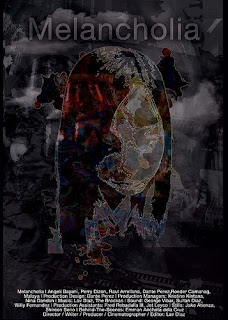
Images Festival 2009: Melancholia (Diaz, 2008)

The length of Melancholia is the default point of interest when I describe the film to people. It is also one of the least important aspects of the film. Running somewhere between seven and a half to eight hours long, it is still only Diaz’s fourth longest film. An amazing thing, though, is that it actually needs to be this long (Okay, it could probably lose an hour and still retain everything that is so magical about it, but the point is there). Diaz often cites his frustration with journalists and press who, when given a rare opportunity to discuss the film with him, only bring up the length, and even worse, to ask ‘why so long?’ His response? ‘Next please.’

The easy summation for the film is that it is about all of the sadness in the world, how every person has so much sorrow and melancholia, and we all have our ways of cloaking this sadness, even though it is always there. But this is to ignore all of the beautiful allegories of art, personas, interpersonal connection, and transformation that are just as prevalent, if not more so. The film is unofficially divided into three distinct ‘chapters’: The first is the Sagada segment in which Alberta is the protagonist, the middle segment primarily focuses on Julian after Sagada (Alberta is important here, too), while the final few hours follows three men through a jungle, all three on the brink of insanity and death. Despite the fact that Diaz has shot the entire film on HD video, the lengths of the shots felt like they were equal to the length of an entire film reel (much like Benning’s lake and sky films). In reality, they were probably a bit longer, probably averaging 13-15 minutes per shot, I would guess. Also, most of these shots are static and fairly distanced from the characters; I don’t think Diaz ever allows a close, clear look at any character’s face. By never distinctly revealing the physical identity of the characters, it keeps them in a constant state of development limbo; there is always something unknown about them.

Speaking of limbo, one of the film’s big ideas relates to purgatory (Diaz even released a short film in the last year or so titled Purgatorio). Characters are caught between locales, personas, and states of mind, and they all realize it. Faced with their sorrow, Julian, Alberta, and Rina all make a sort of pact with each other to assume the roles of completely different people. When we first meet them, Alberta is a prostitute named Jenine, Julian is a pimp named Danny Boy, and Rina is a nun roaming the roads of Sagada begging for ‘charity for the poor.’ The illusion of these characters’ false personas is breached when a man recognizes Alberta and confronts her at a restaurant. She assures him that she is not Alberta, he swears that she looks just like her except for her clothing, but he seems to take her word that she is just a whore named Jenine. Later, when the same man asks ‘Jenine’ for her services, he stops her mid-way through her stripping, finally convinced that she couldn’t be Alberta, because Alberta would never strip like this for a stranger. Of course, though, it is Alberta. That he has become so convinced by this gesture gives an idea of the complete unlikelihood of these roles changes, and the commitment beyond all of their morals that they have agreed to. It’s the ultimate example of method acting.

Post- ‘persona adoption’, the middle segment of the film finds the characters in a deeper ‘purgatory’ than before. Julian seems to be employing performance artists to stage didactic and absurd performances in his living room, as well as a thrash jazz/metal band, who wail on their instruments for a good twenty minutes as Julian wanders around them, grinning and sipping a beer (this part lost the largest chunk of my audience, though it takes place five hours into the film). Alberta, returning to her day job as a school principal (but is it her real day job?…), puts her emotional sterility on hiatus to conduct a new search for a missing loved one, this time for her adopted daughter Hannah, who has, coincidentally, begun pursuing prostitution to ease her troubles over her dead parents. Diaz uses this segment to express his passionate views on various aspects of filmmaking. Julian has a wonderful, extended visit with a writer friend to discuss his new book, ‘The True History of Filipino Cinema’ (I think this is what it was titled; if not, it’s close). Julian asks the friend to tell him a synopsis of the film, and, seemingly representing Lav Diaz himself, the friend becomes irritated that he should have to shrink the content of his work into an abridged form. “Just read the book!” he says. He gives in, though, for the sake of communicating more anecdotes on the problems with Filipino cinema, such as their reliance on big stars, tidy lengths, and heteronormativity.

Julian and Alberta meet in a cafe shortly after this scene, because Julian wants to discuss his irritation with her that she compromised truth and the illusions of their personas in the first segment when she addressed ‘Danny Boy the pimp’ as Julian. This was an intense dissection of what truth actually is when you are acting as someone else. How long do you have to ‘pretend’ to be a whore, actually having sex with strangers, telling people your name is Jenine, before they become your actual identity? We gives ourselves these names, and we dictate our moral boundaries, so why should Alberta the innocent widow still be Alberta the innocent widow? If we completely change our environment, names, morals, troubles and worries, and sources of happiness, then shouldn’t we cease to be who we once were? Beautiful stuff, this film offers.

Following the thrash/noise mind eraser (and exit music, for many), the music abruptly shifts to a jungle, and stays there (this segment is very reminiscent of the second half of Tropical Malady). At first, the three men that the film is now following are unknowns. Eventually, though, we see one of the men writing a letter or poem, with his writing translated in voiceover. He is writing about Alberta, and, thus, his identity is revealed to be Renato, Alberta’s missing husband whose absence has caused her so much grief. This also shifts the time of the film, as our sense of where we are goes back to about ten years earlier than the rest of the film is set. The next two hours shows, in snail-paced detail, the mental and physical disintegration of the three men, who are being hunted by unseen militia. When these scenes shift to night, the images on the screen are impenetrable for well over half an hour, more difficult to dissect, even, than the night scenes from Birdsong. The duration of this time with these men is, frankly, exhausting; their insanity and hopelessness arguably contagious.

The film has a coda, which both summarizes much of the film’s ideas, and also blasts it into hyper-spiritual incomprehension. Alberta has shifted her hunt from Hannah to Julian, who has inexplicably gone missing. Civilians have been replaced by performance artists/meditators/yogis. Alberta encounters a man who tells her that sadness is the source of all art; he is an actor because he has sadness; sorrow is how poets write poetry, and filmmakers create cinema. Alberta finds Julian, who is now God, or at least thinks he is, and accredits himself (God) as the source of all sadness and suffering. He assumes the ideal persona for overcoming his melancholia, by becoming the one who gives it.

Images Festival 2009: Melancholia (Diaz, 2008) Read More »

Cinematheque: The Red and The White (Jancsó, 1967)

In one corner, this could be the most realistic war film ever made; not only realistic in the sense that it can often pass as actual, filmed documentation of battles and wartime, but also that it is showing the situation objectively, and from enough of a distance that all hints of the filmmaker’s intentions remain ambiguous even after it is over. Typical of Mr. Jancsó, the film is shot in very long, elaborately choreographed shots in which the camera circles and maneuvers its way in and around the characters and the action. This can beautify the war in some sections, but leave it stern and brutal in others, depending on how intrusive the camera actually is. At times, the camera, fairly close up, is transitioning from object to object, person to person, so seamlessly and well-choreographed, that it feels too rehearsed, or even too logical. These rare but well-dispersed sequences are the lone circumstance in which Jancsó takes control of the action and his audience, and guides the viewer through precisely what he wants us to see. The camera is usually backed away enough to decide for oneself what, in this busy and chaotic assemblage of violence and backstabbing, to focus on, not dissimilar to the tension and freedom granted from a deep focus conversation.

Regarding the viewer’s attempts of ‘siding’ with someone in the film, there isn’t really a protagonist in which to sympathize; one is able to sympathize with whichever side of the conflict he chooses, and pickin’s are slim, as the title of the film spoils: you have your Communist Reds or your Tsarist Whites. I couldn’t care either way, which brings me to the other corner of the film’s realism: why depict an historical event, that actually happened, and present it as it is here, in glorified realism? Where does that leave the viewer who has no association with the film’s politics? Since the film is based on events that took place just before the 1920s, it is in the realm of possibility that the events here could have been filmed, documented in motion pictures; this is a trait that his The Round-Up does not have since it was set in the early 19th century, before film or any other means of moving pictures were developed. Round-Up entertained the audience’s potential lack of an entry to the material by incorporating a humanist plot to which anyone could relate. Here, though, it comes across as purely a showcase for Jancsó’s skill at directing excessively garnished action sequences; an empty-headed blockbuster. A drawn-out, recreated battle between Reds and Whites is just as banal and pedestrian as your everyday battle of good vs. evil, and is not enough to make this a worthwhile exploration of an important historical event.

Cinematheque: The Red and The White (Jancsó, 1967) Read More »

Cinematheque: Red Psalm (Jancsó, 1972)

This was the only color film by Jancsó in Cinematheque’s series of four early films by the Hungarian filmmaker, as well as the only film shot in the academy ratio, rather than 2.35:1 widescreen, a more appropriate and less oppressive aspect ratio for his mise en scène. Perhaps I developed too much of an appreciation for his usage of the anamorphic scope, but he didn’t seem to adjust his compositional approach to the narrower frame, and therefore much of the action feels cropped here. Anyway, the film tracks a collective of Hungarian civilians who are participating in a protest or revolt, or perhaps they are reenacting a protest or revolt; it is difficult to decipher if this film is set in its 1890 setting or if it takes place in the present. There are some surreal moments early on, such as when a woman is shot in her hand, and the bloody wound miraculously becomes a red ribbon, or when a man is seemingly shot dead, but then stands right back up and continues his participation in the protest. These moments make the rest of the film fairly ambiguous in terms of its adherence to reality or its reliance on fantasy. Characters are shot (by guns), and it is unclear if they are really wounded or dead or not. The wounds, like bullet holes or cuts from knives, have obviously fake blood, and yet it is unclear if it is fake blood in the character’s universe, or just low-budget filmmaking. Some might praise this confusion of reality and fiction, but it is maddening in this film because it doesn’t make a difference either way. If it is a reenactment or if it is just a filmed account of the revolt, it’s still the same film. So why is it so irritating, then, if it doesn’t matter? Because this ‘revolt’ is a massive bore, and the viewer has no reason to care about any characters, nor the collective of people. If one doesn’t have an adequate knowledge of the Hungarian revolution from the mid-19th century, this film will do little to educate or give insight. The characters are also singing and dancing through much of the film. My sensitivity to musicals seems to be increasing, after my issues with Terrence Davies’ early films of family sing-alongs, and now with these anarchist folk songs that similarly mean nothing to me. 87 minutes rarely passes so slowly.

Cinematheque: Red Psalm (Jancsó, 1972) Read More »

Cinematheque: The Round-Up (Jancsó, 1966)

The relative plotlessness of Silence and Cry, which carries over and progresses still in The Red and The White and Red Psalm, seems more like an evolution of style than the conscious decision that I perceived it to be, as The Round-Up is both the earliest and the most plot-driven film of the four in this retrospective. Not quite Jancsó’s break-through film, it’s not difficult to see why he made it so big after this. It isn’t as spatially and compositionally beautiful as Silence and Cry, but the action of the film is so much more engaging (the word ‘engaging’ is very much relative to the rest of Jancsó’s work that I’ve seen, as there is still not much going on here). The plot, which might have been partially borrowed for Hillcoat’s The Proposition, begins with the head of an army trying to weed out the worst of his lot of men who participated in guerilla violence. One man, who killed three men, is told that if he can find another man in the lot who killed more men than he did, then he will be pardoned. The film tracks his search, and recreates the forts in which these men were held captive, including dark cages where men would be stored without light or contact with the other prisoners. The army proves to be quite corrupt, of course, and takes every chance they can to abuse their power. The film shows the injustices toward a large group of men, and has emotional success because it follows a couple of select men and develops their characters and situations, a trait I thought was detrimentally absent in his next couple of films.

The film’s cinematography, which as I mentioned is not as striking here as it was in Silence and Cry, opts for shorter takes, but focuses more on patterns than the follow-up film’s study on depth and placement in space. In particular, line-ups of soldiers and prisoners, especially when they are in motion, create a kind of Op art effect on the screen, much in the way a field of cotton can be so dazzling when one drives by in a car, as the repetitious order of everything looks so artificial in nature, and is so exact that subtle patterns appear. Watching the army march is wonderful, especially to focus on the light that comes through between each men’s legs. Against the back-drop of the Hungarian planes, rolling hills, and intermittent forests (whose trees are similarly ordered), Jancsó draws inevitable comparisons between the men’s behavior and the peace and freedom of nature.

Jancsó’s films have a motif of men shooting men in their backs as they are walking away from a conversation or meeting. It’s an obvious but effective metaphor for how Jancsó believes power is handled when it is obtained by corrupt men.

Cinematheque: The Round-Up (Jancsó, 1966) Read More »

Cinematheque: Silence and Cry (Jancsó, 1967)

Part of a mini-retrospective on Miklós Jancsó at the Cinematheque Ontario this weekend, Silence and Cry is the first of four films in the series, presumably his most significant four, which showed last night as part of a double feature. The films aren’t being shown chronologically, as they followed up this film with The Round-Up, made one year previous to this one. I suppose there is either a thematic or temporal reason for their arrangement which is, as of right now, unknown to me; thus, I won’t really say much more right now about the four films as a quadrilogy, or any other relation, except that they were all made my Miklós Jancsó in the span of six years.

The main hype about Jancsó is his camera work, specifically his long, languid takes. They aren’t Béla Tarr long, or even close to it; nor are they as monodirectional. Where Tarr will generally set his camera in a path that continues to progress into new territory, Jancsó roams a plane through and through, ritualistically, until its three-dimensionality is certain. While one often identifies the activity on-screen as being in the top or bottom, left or right of the frame, such ‘x and y’ graphing is not nearly adequate for these compositions; a ‘z’ is most definitely required. A figure in the top left corner of the frame isn’t in the top left corner of the frame, but is one hundred yards ahead and a few meters to the left. In staging these scenes, often framing scores of extras and characters, in their entirety, and capturing it all so thoroughly between each cut, the events depicted in the film gain a remarkable air of realism, as if some scenes are documenting the actual revolution.

As much as the film realistically portrays these historical events and the people and spaces surrounding it, it also cryptically eavesdrops on a few characters’ personal lives, muddily portraying a love triangle between István, our protagonist, and the two ladies on the farm who are poisoning a man and older woman, one of the ladies’ mother. The film is relaxed and meandering, mostly attributed to the camera and its drifting motions. Regardless of the drama brought in by our three ‘leads,’ the camera is the true star of this film, using the 2.35:1 format efficiently and deliberately; this film’s compositions just wouldn’t work in the typically more desirable academy ratio. The space, time, and mannerisms of the people captured in the lensing are much more telling of Jancsó as an artist than any expository theatrics could be.

Cinematheque: Silence and Cry (Jancsó, 1967) Read More »

DVD: The Exterminating Angel (Buñuel, 1962)

As a film about a large group of characters trapped in a single room in a mansion, Buñuel’s mise en scène here has just as much opportunity as his symbols and ideals. Locking the characters into a single room (and the size of the room isn’t exactly adequate for the dozen+ guests) the camera is also isolated in the room, and, therefore, also the viewer. Or… not exactly. A fatal flaw in Buñuel’s découpage of Exterminating Angel is that the viewer is not confined to the room like all of the guests. The camera, on a few occasions, is propped in the adjacent dining room, looking in at the prisoners, as if to mock them. And later, the film takes us outside the actual mansion, to see, and spend a bit of time with, the public, press, and security, who are aware that there are many people in the mansion, and that they have been there for a very long time. This kills me, because it eliminates one of my favorite ideas from the former half of the film, which is that the outside world could be just as psychologically ‘off’ and physically trapped as they are; or better yet, that the world has reached a full-blown apocalypse. Sure, this is probably just not what Sr. Buñuel had in mind. He wants to poke fun at the bourgeois, at societal conventions, and religion. And all of these themes are presented very, very well in this film. But, oh, how it could have been so much more!

Releasing the viewer into the dining room does nothing positive for this film. In Stalker, Tarkovsky blows your mind by thrusting you into The Room that our three protagonist’s cop out on entering. Sitting in the Room, for who knows how many minutes, with the water leaking in around the camera, is as close to a religious experience as an unreligious viewer can get. Thus, placing the camera, the viewer, in this space that the characters are unable to enter gives the viewer a sense of power, and also a bit of knowledge and perspective that the characters will not have; a kind of dramatic irony of space. In Angel, looking in from the dining room at these characters, who may as well be looking in to a literal fourth wall, we have a sense of power over these characters, and we have that perspective, too. But there is no revelation or satisfaction that comes from this hierarchy of control, because the viewer isn’t the one who is willing himself into ‘the outside,’ the one overcoming this psychological, environmental, spatial crisis; it’s Buñuel. We are able to escape the room because his camera says we can. Once we are allowed outside of the mansion, too, the confinements of space no longer matter, and are no longer interesting. We become purely spectators to this crisis instead of participants. There’s a ton of enjoyment in this as a spectator, but the game was so much more fun when it was more than that.

DVD: The Exterminating Angel (Buñuel, 1962) Read More »

Cinematheque: Lola Montes (Ophuls, 1955)

Lola Montes is a spectacle film and not too much more, but what it does it does very well. The opening of the film, coinciding with the opening of the circus, is glorious, ambitious, and dazzling. Deep reds and blues and sparkling jewels are everywhere; rows of performers juggle in synchronization, the music is blaring, and the beautiful Lola is paraded out, stoic and iconic, all while the camera whirls and twirls in and around everything. It’s a brilliant introduction, but a fatal one, as nothing in the film comes close to satisfying what these first few minutes set up. That is not to say that the grandeur is not sustained; every moment of the circus that plays out throughout the film is equally dazzling and entertaining, but the lack of progression is irksome, mainly because, as the meat of the story progresses in intermittent flashbacks, the substance of Ophuls’ vision wears thinner and thinner, until it is completely transparent, leaving only the trumpets, lights, and the show as its contribution.

There are occasional bits that work, though. Lola’s relationship with her mother is well established, and provided rare insight into the isolating fame and stunted growth that defined her developing years. Lola, despite being in her late teens, still desires to share a cabin with her mother, who would secretly rather share her cabin with a man. Lola goes off to sleep in the dormitory with the other kiddies, and is teased for bursting into tears, knowing now that her happiness is not her mother’s sole passion. And later, the arbitrary satisfaction of Lola’s love is brilliantly shown as her lover hires an artist to paint a portrait of Lola. He takes great care to select the slowest, more meticulous painter, and encourages his mistakes and redos so that Lola will be obligated to stick around (or that he will have a reason to keep her around).

Lola is courted by four men (four of supposedly over a dozen lovers from her life, if her circus master and current hubby are to be believed) throughout the film, one for each season. This roundabout coverage of the course of a year, and drama and seemingly imminent doom of her brush with death at the end make this film seem like it is a complete account of Lola’s life. We’ve seen her spring, summer, autumn, and winter flings, her adolescence, her exploitation, and her general lifelessness (which is only interrupted in the film’s best scene in which she interrupts a performance to stomp through and over a party to approach her lover’s wife). The long, flowing line of men and boys paying to touch or kiss Lola is disturbingly endless, turning her into a kind of family-friendly whore. It’s a satisfying ending to a dry, engaging, and busy film about a woman who doesn’t deserve one.

Cinematheque: Lola Montes (Ophuls, 1955) Read More »